
Imagine finding a coin that was minted at the exact moment a new country was born. You can’t spend it, you can’t trade it, but everyone knows exactly when and why it was created. That’s essentially what the Genesis Block is for Bitcoin. It is not just the first entry in the ledger; it is the anchor that holds the entire network together. Without this specific block, mined on January 3, 2009, there would be no Bitcoin, no Ethereum, and arguably no modern decentralized finance. But why does one single data point carry so much weight? The answer lies in a mix of cryptographic necessity, historical symbolism, and a technical quirk that makes its initial reward permanently locked.
The Technical Backbone of the Chain
To understand why the Genesis Block is special, you have to look at how blockchain works. Every block after the first contains a reference to the hash of the previous block. This creates a chain. If you change anything in an old block, its hash changes, breaking the link to the next block. The Genesis Block is unique because it has no predecessor. It doesn’t point to any previous hash. Instead, it serves as the starting coordinate for the entire mathematical structure. In Bitcoin code, it is hardcoded into the software. This means every node on the network agrees on exactly what the first block looks like without needing to download it from another peer. It is immutable by design. If you tried to alter the Genesis Block, you wouldn’t just be changing one record; you would be invalidating every transaction that happened since 2009.
The Unspendable Reward: A Symbol or a Bug?
Here is where things get interesting. When Satoshi Nakamoto mined the Genesis Block, the protocol awarded the standard 50 BTC block subsidy. These coins were sent to the address 1A1zP1eP5QGefi2DMPTfTL5SLmv7DivfNa. However, if you try to spend these coins today, you’ll find they are stuck. They are technically in the UTXO set (Unspent Transaction Outputs), but they cannot be moved. Why? Because of a subtle coding detail in the Genesis Block’s coinbase transaction. The script size is slightly different from standard transactions, making them invalid for spending under current rules. Was this intentional? Some experts, like Dr. Sarah Meiklejohn from University College London, suggest it might have been a technical oversight during the early development phase. Others view it as a deliberate symbolic gesture, ensuring that the creator’s first earnings remain a monument rather than currency. Either way, those 50 BTC serve as a permanent reminder of Bitcoin’s origins, worth far more as a historical artifact than as spendable money.
The Newspaper Headline: A Message in the Code
Beyond the math, the Genesis Block contains a message. Embedded in the coinbase field is the text: "The Times 03/Jan/2009 Chancellor on brink of second bailout for banks." This line comes from the front page of The Times newspaper on the day the block was mined. It serves two purposes. First, it acts as a timestamp, proving the block wasn’t generated earlier and backdated. Second, it articulates the core motivation behind Bitcoin: a response to the instability of traditional banking systems during the 2008 financial crisis. This isn’t just data; it’s a manifesto. It tells anyone reading the code that Bitcoin exists to provide a neutral, decentralized alternative to centralized financial control. Sixteen years later, this headline still resonates with the community, serving as a constant reminder of why the technology was built.

Comparison with Other Blockchain Origins
Not all genesis blocks are created equal. While Bitcoin’s first block locks away its reward, many other cryptocurrencies took a different approach. For instance, Ethereum’s genesis block, launched in 2015, distributed approximately 72 million ETH through a public sale. Ripple’s genesis ledger pre-mined 100 billion XRP tokens, with a significant portion held by the founding company. According to industry analysis, about 85% of major cryptocurrencies feature spendable founder allocations in their genesis blocks. Bitcoin stands out because its creator left no personal stake in the circulating supply. This distinction matters. It reinforces the idea that Bitcoin belongs to no single entity, unlike networks where founders retain large voting rights or supply control. The comparison highlights Bitcoin’s unique position as the original, permissionless experiment.
| Cryptocurrency | Launch Date | Initial Reward/Supply Status | Founder Allocation Spendable? |
|---|---|---|---|
| Bitcoin | Jan 3, 2009 | 50 BTC (Locked) | No |
| Ethereum | Jul 30, 2015 | ~72 Million ETH (Sold) | Yes |
| Ripple (XRP) | 2012 | 100 Billion XRP (Pre-mined) | Yes |
Security and Immutability: The Anchor Point
The Genesis Block is the ultimate source of security for Bitcoin. Every transaction ever made is cryptographically linked back to this first block. If you want to verify that you own a certain amount of Bitcoin, your wallet traces the path of ownership all the way down to the Genesis Block. This unbroken chain of custody has never been broken. Even with billions of dollars in value moving daily, the integrity of the chain relies on the immutability of Block 0. Recent updates to Bitcoin Core, such as version 26.0 released in March 2025, have even added enhanced verification checks specifically for the Genesis Block, underscoring its critical role in network security. It is the bedrock upon which trust is built, not through faith in a central authority, but through mathematical certainty.
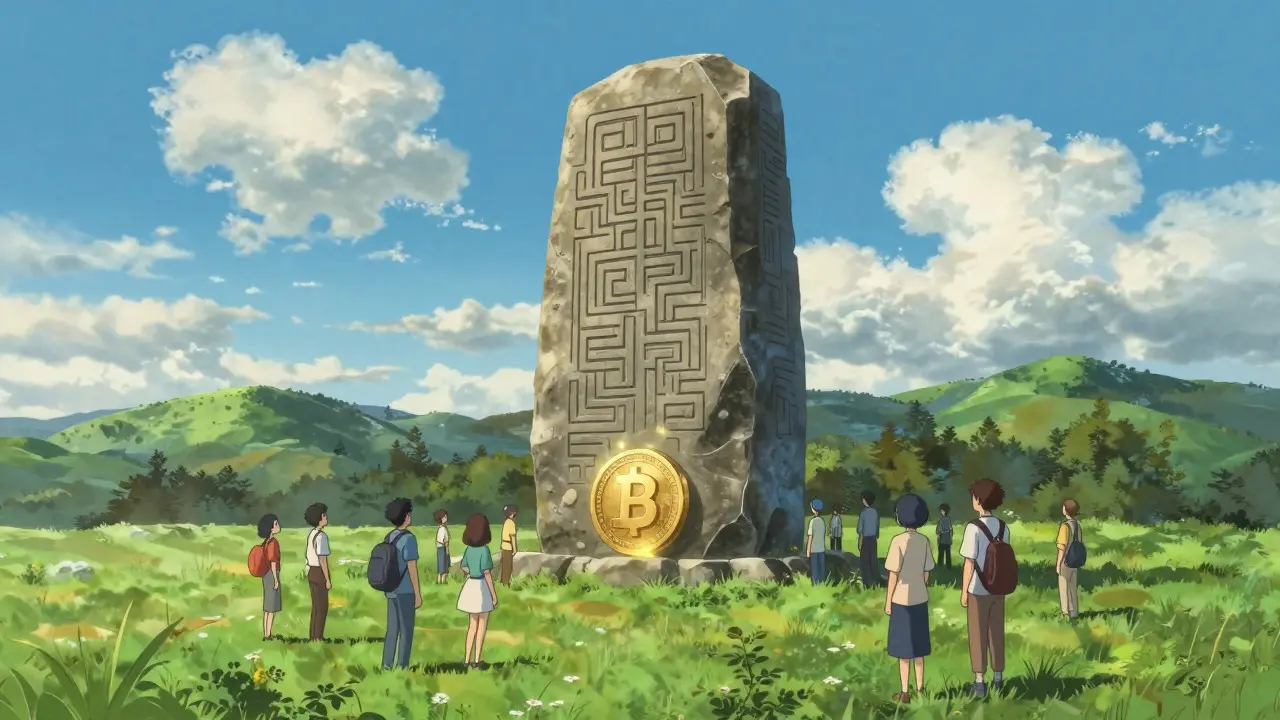
Cultural Impact and Community Reverence
For the Bitcoin community, the Genesis Block is more than code; it’s a cultural icon. On the 16th anniversary of Bitcoin in January 2025, gatherings were held in over 67 countries to commemorate the event. The Computer History Museum added a physical representation of the Genesis Block hash to its permanent exhibit. This reverence stems from the block’s dual nature as both a technical milestone and a philosophical statement. It represents the moment when a theoretical concept became a working reality. For newcomers, understanding the Genesis Block is often the first step in grasping why decentralization matters. It shows that a global financial system can be started by one person, with no permission needed, and maintained by thousands of independent nodes.
Frequently Asked Questions
Can the Genesis Block be modified?
Technically, no. It is hardcoded into the Bitcoin client software. Any attempt to modify it would create a divergent chain that is incompatible with the main network, effectively rendering the modification meaningless for the majority of users.
Who owns the 50 BTC in the Genesis Block?
They are associated with Satoshi Nakamoto’s address, but they are unspendable. Since they cannot be moved, they are effectively owned by the protocol itself, serving as a historical marker rather than a financial asset.
Why is the newspaper headline important?
It provides cryptographic proof of the block’s creation date and communicates the political and economic context that inspired Bitcoin’s creation, specifically the distrust of traditional banking systems post-2008.
How does the Genesis Block differ from other blocks?
It lacks a previous block hash, contains a hardcoded difficulty target, and includes a non-spendable coinbase reward. These features make it structurally and functionally distinct from all subsequent blocks in the chain.
Is the Genesis Block relevant to mining today?
Miners don’t interact with it directly, but every new block they mine must ultimately validate against the rules established in the Genesis Block. It sets the foundational parameters for the proof-of-work algorithm and consensus rules that miners follow.

Kate Staab
August 22, 2026 AT 14:36Oh, how quaint. Another tech article pretending that a digital artifact is some kind of moral beacon. We are all so very special for trusting a math equation instead of a bank, aren't we? It’s almost adorable how the community clings to this 'genesis' narrative like it’s a religious text. The unspendable coins aren’t a monument; they’re just code that didn’t work as intended, dressed up in philosophical language. But sure, let’s keep worshipping the block. It keeps the dreamers warm at night.
Tasha Davis
August 23, 2026 AT 00:06I love this stuff! It really shows why Bitcoin is different from everything else out there. Most people don't even know what a genesis block is, but it's super cool that it's locked forever. It feels like a promise that the system will always be fair because no one can cheat the start. I'm so excited about where crypto is going next!
Leah Humphrey
August 23, 2026 AT 03:14The immutability argument is technically sound but practically irrelevant for most users. The UTXO set validation overhead is negligible compared to the consensus mechanism's reliance on proof-of-work. What matters is the hash pointer integrity, not the symbolic weight of the coinbase script. The 'oversight' theory holds more water than the intentional design hypothesis when you look at the early commit logs. It was likely a serialization bug in the initial C++ implementation that got cemented into the protocol due to network inertia.
Jay Johhnston
August 23, 2026 AT 14:14It is fascinating to see how a single line of code became a cultural touchstone. In many parts of the world, the idea of a decentralized ledger is still abstract, but the Genesis Block serves as a concrete anchor point for understanding trust without intermediaries. It bridges the gap between theoretical cryptography and real-world application beautifully.
Stephanie Millar
August 23, 2026 AT 23:07Indeed! -- And isn't it remarkable, truly remarkable, that such a simple concept -- a starting point -- has spawned an entire global economy?! The symbolism is profound! One must appreciate the elegance with which the founders embedded their intent into the very fabric of the chain! It is, quite simply, a masterpiece of modern engineering and philosophy combined!
miranda gamboa
August 25, 2026 AT 00:00Let's dig deeper into the cryptographic implications here. The hardcoded difficulty target in the genesis block sets the baseline for the PoW algorithm's adjustment intervals. This creates a deterministic path for mining difficulty that is independent of external market forces initially. Understanding this helps us see why the network has remained stable despite massive changes in hashrate. It's a beautiful example of emergent order from simple rules.
Uday N M
August 25, 2026 AT 03:54Good. Technology belongs to those who build it. No foreign banks needed.
Melissa G
August 26, 2026 AT 15:05The Genesis Block represents a unique intersection of technical determinism and human intentionality. While the code is immutable, the interpretation of its significance remains fluid within the community. This duality mirrors broader philosophical questions about the nature of value: is it intrinsic to the object, or is it constructed by the collective agreement of its participants? The locked coins serve as a permanent reminder that some things are meant to be preserved, not consumed.
Claudio Perrone
August 28, 2026 AT 08:48its basically a magic trick right? satoshi knew he couldnt spend them so he just left them there to make us feel special. i think its a psyop to keep us loyal to the chain. if he wanted to be nice he would have made them spendable. now they are just digital dust. very deep. very mysterious. probably watching us from the blockchain.
Aaron Morrissey
August 28, 2026 AT 13:01A rather charming, albeit speculative, perspective. One might argue that the 'unspendable' nature of these coins functions as a form of cryptographic altruism, a sacrifice of potential liquidity for the sake of historical permanence. It transforms a financial instrument into a museum piece, a testament to the origins of our digital age. Such nuances often escape the casual observer, yet they form the bedrock of our shared technological heritage.
Patrick Quairoli
August 28, 2026 AT 15:38they say its locked but its not really. satoshi has the private key. he just waits for the right moment to dump it all on us. thats why the price crashes every few years. its a hidden supply shock waiting to happen. dont trust the code, trust the data. the data says satoshi is alive and kicking. watch your wallets.
Linda Leeuwesteijn
August 30, 2026 AT 14:38Love this explanation! 🌟 It makes me feel so much more connected to the history of Bitcoin. The newspaper headline is such a cool detail too. Thanks for sharing! 🙌
Sarah Campbell
September 1, 2026 AT 12:25Finally someone gets it! 🇺🇸 American innovation at its finest! No government, no banks, just pure freedom! Those other countries with their pre-mined tokens are fakes anyway. Bitcoin is the only real money. Let's go! 💰🚀
Phelan Deihl
September 3, 2026 AT 06:35I've been thinking about this a lot lately. The way the genesis block anchors the whole system is pretty quiet but powerful. It doesn't shout, it just sits there, holding everything together. There's something comforting about that stability, even if you don't use it yourself.
Ami Elizabeth
September 4, 2026 AT 21:53cool post. never thought about the fact that the first block is hardcoded. makes sense tho. otherwise everyone would fight over who started it. good read man.