
Most blockchains feel like trying to run a modern video game on a calculator. They are slow, expensive, and terrible at handling complex data. Chromia (CHR) is a Layer-1 modular relational blockchain network designed to solve these exact problems by merging familiar SQL database structures with decentralized security. If you have ever wondered why your favorite Web3 game lags or why DeFi apps struggle with heavy data loads, Chromia aims to fix that. It isn't just another coin; it is an infrastructure play targeting high-performance sectors like gaming, artificial intelligence, and real-world assets.
As of July 2026, CHR trades around $0.015, sitting far below its 2021 peak but building a more mature foundation. The project has moved from being just a token on Ethereum to running its own native mainnet. Let's break down what makes this "relational blockchain" different, how the CHR token actually works, and whether it has legs in today's market.
The Core Problem: Why Blockchains Struggle with Data
To understand Chromia, you first need to understand what it is fighting against. Traditional blockchains like Ethereum use a key-value store model. Think of it like a simple notebook where every piece of information is written on a separate line without context. If you want to find out who owns which sword in a game, the blockchain has to read thousands of individual lines to connect the dots. This process is called querying, and it is incredibly slow and expensive on most chains.
ChromaWay AB, the Swedish company behind Chromia, built their network using a relational database model similar to SQL systems used in traditional software development. In a relational database, data is organized into tables with clear relationships. If User A buys Sword B, the system links them instantly. This allows developers to build complex applications-like massively multiplayer online games or AI training environments-without sacrificing speed.
This architecture bridges the gap between Web2 efficiency and Web3 decentralization. Developers don't need to learn entirely new programming languages or abandon their existing tools. They can use familiar database logic while benefiting from blockchain immutability and security.
How Chromia Architecture Works
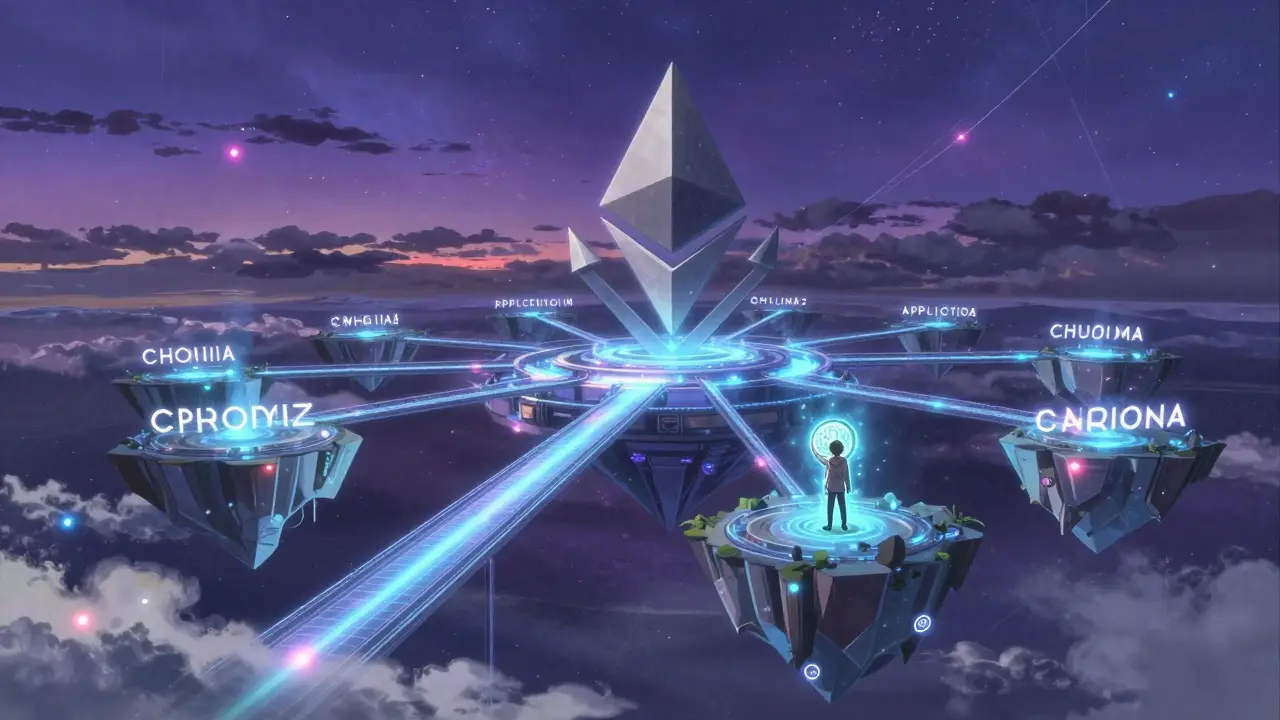
Chromia operates as a modular Layer-1 network. Instead of one giant chain trying to do everything, it uses a multi-chain architecture. Each decentralized application (dApp) runs on its own dedicated chain within the Chromia ecosystem. These application chains are operated by providers who stake CHR tokens to secure the network.
Here is how the pieces fit together:
- Relational Indexing: Data is stored in structured tables, allowing for fast reads and writes. This is crucial for games that track inventory, player stats, and world states in real-time.
- Modular Design: Applications are isolated. If one dApp gets congested, it doesn't crash the entire network. This horizontal scaling means the network can grow infinitely by adding more provider nodes.
- Ethereum Anchoring: While Chromia handles the heavy lifting, it periodically commits state hashes to the Ethereum mainnet. This gives Chromia the security guarantees of Ethereum without inheriting its bottlenecks.
- Native Fees: Unlike many early projects that relied on wrapped tokens, Chromia now supports native CHR fees. Providers are compensated directly in CHR for hosting dApps, creating a sustainable economic loop.
This setup makes Chromia particularly attractive for data-intensive workloads. For example, an AI model needs to process structured datasets on-chain. A standard smart contract chain would choke on this. Chromia’s relational structure handles it naturally.
CHR Tokenomics: Supply, Distribution, and Utility
The CHR token is the fuel that keeps the Chromia engine running. Understanding its supply dynamics is critical because it affects long-term value. Originally, the max supply was set at 1 billion CHR. However, in May 2020, approximately 22 million tokens were burned, reducing the hard cap to about 978 million CHR. As of mid-2026, the circulating supply hovers around 970-974 million tokens, meaning almost all allocated tokens are already in circulation.
| Allocation Category | Percentage | Purpose |
|---|---|---|
| Ecosystem Fund | 37.25% | Growth grants, developer incentives, and partnerships |
| Promotional Fund | 25% | Marketing, community building, and awareness campaigns |
| Private Sale | 19.4% | Early investors and venture capital firms |
| Founders | 4.5% | Core team leadership and founders |
| IEO (Initial Exchange Offering) | 4% | Public sale participants via exchanges |
| Auto Conversion Contract | 3% | Technical mechanisms for cross-chain bridging |
| Team | 2.93% | Employee compensation and retention |
| System Node Compensation | 2% | Rewards for network providers securing the chain |
| Advisors | 1.92% | Strategic guidance and industry experts |
Notice that over 62% of the supply is dedicated to ecosystem growth and promotion, rather than insiders. This suggests a focus on long-term adoption rather than quick exits. The primary utilities of holding CHR include:
- Paying Network Fees: Users pay CHR for transactions and dApp interactions.
- Staking for Security: Validators stake CHR to operate node services and earn rewards.
- Governance: Token holders participate in decision-making processes regarding protocol upgrades.
- Reserve Asset: dApps can peg their own secondary tokens to CHR, creating demand for the base currency.
Market Performance and Price History
Like many altcoins, CHR has seen dramatic swings. During the 2021 metaverse and GameFi boom, CHR reached an all-time high of $1.49 in November. At that time, the narrative around blockchain gaming was at its peak, and Chromia’s technical advantages resonated with speculative buyers.
By July 2026, the price has corrected significantly to around $0.015. This represents a drop of roughly 99% from its peak. However, looking at raw price decline misses the context. The crypto market as a whole has experienced multiple cycles of expansion and contraction. More importantly, Chromia launched its fully functional native mainnet in 2024, years after the token was first listed. Early investors were buying a promise; current holders are buying a working product.
Current market data shows a market capitalization near $15 million, ranking it in the mid-800s among cryptocurrencies. While this places it outside the top-tier giants, it also means there is room for growth if adoption increases. Trading volume remains steady, with daily volumes often exceeding $12 million, indicating active interest from traders and institutional players alike.
Real-World Use Cases: Gaming, DeFi, and AI
Technology only matters if people use it. Chromia has focused heavily on three verticals where its relational architecture shines.
Web3 Gaming: Games require constant updates to player states, inventories, and leaderboards. Chromia’s ability to handle complex queries makes it ideal for this. My Neighbor Alice is a prominent blockchain-based multiplayer builder game built on Chromia, demonstrating how the platform supports engaging, graphics-rich experiences without lag.
DeFi Protocols: Decentralized finance needs transparency and speed. ColorPool is an automated market maker (AMM) DEX that launched on Chromia in June 2026, enabling on-chain liquidity, staking, and farming. This launch marked a major milestone, proving that Chromia can support sophisticated financial instruments.
AI and Real-World Assets (RWAs): As AI models require verifiable data sources, Chromia offers a way to store and query structured datasets on-chain. Additionally, tokenizing real-world assets like property or commodities requires robust record-keeping, which fits perfectly into Chromia’s relational model.

How to Get Started with Chromia
If you want to interact with the Chromia ecosystem, here is the practical path forward. First, you need to acquire CHR. You can buy it on major exchanges like Binance, Gate.io, Bybit, or KuCoin. Once purchased, you have two options: keep it on the exchange for trading, or move it to a self-custody wallet to participate in the network.
For self-custody, wallets like SafePal support CHR. To register a Chromia account on the Economy Chain, you typically need to stake or bridge at least 10 CHR. This small threshold prevents spam while keeping entry accessible. From there, you can start using dApps, staking your tokens for rewards, or even developing your own applications using Chromia’s developer tools.
Risks and Challenges
No investment is without risk. Chromia faces stiff competition from other Layer-1 and Layer-2 solutions. While its relational database approach is unique, developers may prefer sticking to established ecosystems like Ethereum or Solana due to network effects. Furthermore, on-chain adoption metrics remain modest compared to industry leaders. The gap between technical potential and actual user activity is the classic challenge for niche blockchains.
Additionally, the cryptocurrency market is highly volatile. A 99% drop from ATH is not unusual in this sector, but it highlights the speculative nature of CHR. Investors should consider their risk tolerance and diversify accordingly.
Is Chromia (CHR) a good investment in 2026?
Whether CHR is a good investment depends on your belief in the future of relational blockchains for gaming and AI. With a low market cap and a working mainnet, it offers high upside potential if adoption grows. However, it carries significant volatility risks and competes with larger, more established networks. Always do your own research before investing.
What is the difference between Chromia and Ethereum?
Ethereum uses a key-value store model, which is less efficient for complex data queries. Chromia uses a relational database model (like SQL), making it faster and cheaper for data-heavy applications like games and AI. Chromia also anchors its security to Ethereum, combining scalability with Ethereum’s trustlessness.
Who created Chromia?
Chromia was developed by ChromaWay AB, a Swedish blockchain pioneer. The company focuses on building infrastructure for scalable, data-intensive decentralized applications rather than just issuing a token.
Can I stake CHR to earn rewards?
Yes, you can stake CHR to secure the network and participate in governance. Staking rewards vary based on network conditions and provider strategies. Historically, yields have been competitive, though they fluctuate over time.
What is the maximum supply of CHR?
The maximum supply of CHR is approximately 978 million tokens. This cap was established after a burn event in 2020 that reduced the original 1 billion supply. Most of these tokens are already in circulation as of 2026.

Natalie Lucas
July 7, 2026 AT 07:04omg this is actually so cool!! i never thought about blockchains needing sql structures before but it makes total sense for gaming. like why are we still using that old key-value stuff when games need real time data? chromia sounds like the future lol
Brad Semp
July 8, 2026 AT 02:00The premise of this article is fundamentally flawed in its assumption that relational databases solve the decentralization trilemma. While SQL is efficient for centralized systems, introducing such complexity into a distributed ledger inevitably creates single points of failure and compromises the immutable nature of the chain. It is merely a band-aid on a broken limb.
Korn Arrieta
July 9, 2026 AT 19:27You are missing the point entirely Brad. The whole point is modularity. Each app has its own chain so if one fails it doesnt take down the network. Your elitist view ignores the actual engineering benefits of horizontal scaling. Chromia anchors to Ethereum for security so you get the best of both worlds without the gas fees killing your wallet. Stop crying about decentralization purity when you cant even run a simple game on ETH without paying $50 in fees.
Steven Briggs
July 11, 2026 AT 07:22i guess that makes sense. i just worry about the token price dropping so much though. 99% from ath is scary. maybe it will recover but hard to say.
Kim Kay
July 12, 2026 AT 15:00its okay to be scared steven. crypto is volatile. but look at the fundamentals they have a working mainnet now not just hype. also the supply is mostly circulating so less inflation pressure. i think its worth watching closely
Jackie D
July 13, 2026 AT 22:16wait wait wait... so if i buy chr i can actually play games with my tokens or just stake them? that sounds way better than holding eth and hoping for the moon. i love how colorful this tech stack is compared to the usual boring defi protocols. does anyone know if safepal is easy to use for beginners?
Ruth Williams
July 15, 2026 AT 06:45It is imperative that one understands the distinction between utility and speculation. The fact that Chromia utilizes a relational model does not automatically confer value. One must scrutinize the adoption metrics which remain abysmal compared to Solana or Ethereum. Do not be seduced by technical jargon; look at the daily active users. They are nonexistent.
Sophie Nakasako
July 17, 2026 AT 03:48I see what you mean Ruth but isn't it possible that early adopters haven't fully migrated yet? My Neighbor Alice shows there is potential for user engagement. Maybe the AI integration will drive new traffic soon. We should consider the long term vision rather than just current stats. What do you think about the ColorPool launch?
Kristy Morrow
July 18, 2026 AT 01:28you all are sleeping on this. everyone says chromia is dead but its just waking up. the ai angle is huge right now. structured data on chain is exactly what llms need for verification. stop looking at past prices and look at where the tech is heading. its either genius or garbage but definitely not boring