Nigeria Crypto Exchange License Checker
Select an exchange to check its license status
How it worksSee whether exchanges are licensed by Nigeria's SEC and understand key compliance differences
There’s no simple answer to whether crypto exchanges are banned in Nigeria - because they aren’t, not exactly. Instead, Nigeria has shifted from outright bans to a strict licensing system. If an exchange doesn’t have a license from the Securities and Exchange Commission (SEC), it’s effectively blocked from offering Naira services. But users can still access unlicensed platforms using VPNs - even if it’s not legal.
What Changed in Nigeria’s Crypto Rules?
Before March 2025, Nigeria’s crypto scene was in chaos. In 2021, the Central Bank of Nigeria (CBN) told banks to cut off services to crypto businesses. That didn’t stop people from trading - it just made it harder. By late 2023, the CBN reversed course and allowed banks to work with licensed crypto firms. Then, in March 2025, President Bola Ahmed Tinubu signed the Investments and Securities Act (ISA 2025), which completely rewrote the rules. This new law treats digital assets like securities. That means any exchange offering trading, custody, or conversion of crypto to Naira must get licensed by the SEC. Unlicensed platforms can’t legally accept Naira deposits or withdrawals. They can’t advertise. They can’t partner with Nigerian banks. But they can still operate in the background - if users find a way around the blocks.Which Exchanges Are Actually Banned?
The SEC hasn’t published a public list of banned exchanges. But here’s what we know: any platform without a license is operating illegally under Nigeria’s new framework. That includes most international exchanges that haven’t applied for or received approval. Binance is the most talked-about case. In February 2024, Binance stopped Naira trading on its peer-to-peer platform. Nigerian telecom providers blocked access to binance.com. But users can still log in, hold crypto, and send it to external wallets. They just can’t deposit or withdraw Naira directly. So Binance isn’t banned - it’s restricted. It’s like a store that can’t take cash but still lets you walk in with your own money. Other major international exchanges like Kraken, Coinbase, and Bybit have not applied for Nigerian licenses as of late 2025. That means they’re not officially allowed to serve Nigerian customers for Naira transactions. But again, users access them via VPNs. The SEC doesn’t shut down websites - it shuts down partnerships. If a Nigerian bank tries to process payments for an unlicensed exchange, the bank gets fined.Which Exchanges Are Licensed and Legal?
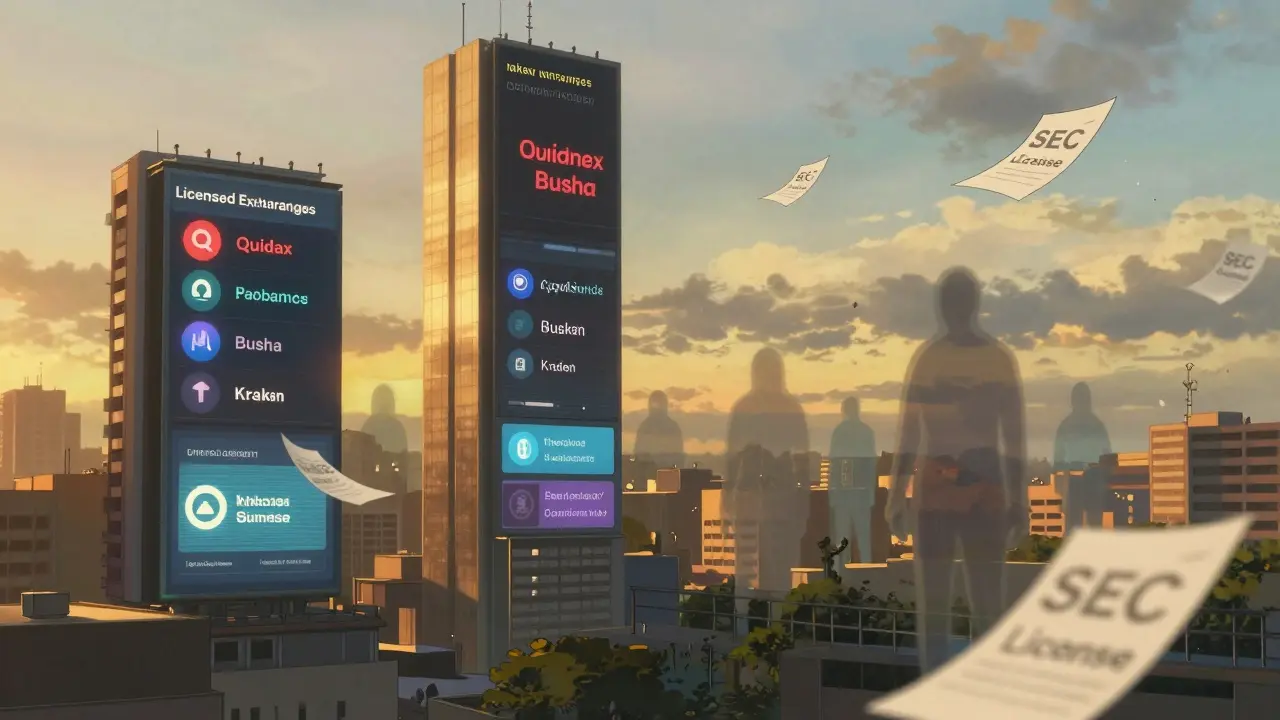
Only two exchanges have received full SEC licensing so far: Quidax and Busha. Both are Nigerian-founded platforms that built their systems to meet strict compliance standards. These licensed exchanges must:- Verify every user’s identity (KYC)
- Monitor all transactions for money laundering (AML)
- Keep detailed records for at least five years
- Report suspicious activity to the Nigerian Financial Intelligence Unit (NFIU)
- Have a local physical presence and registered business in Nigeria
Why Can’t More Exchanges Get Licensed?
Getting a license isn’t easy. The SEC requires detailed documentation on technical infrastructure, financial backing, cybersecurity, and compliance staff. Smaller exchanges can’t afford the legal teams or IT systems needed. One startup founder told a local tech magazine it took 11 months just to prepare the application - and they still got rejected on the first try. The SEC also runs a regulatory sandbox for testing new crypto products. But only companies with strong capital and proven tech can join. That means most international exchanges - especially those based outside Africa - don’t bother. The cost and complexity aren’t worth it unless they plan to scale big in Nigeria.What Happens If You Use a Banned Exchange?
There’s no law saying you, the user, will go to jail for using Binance or Coinbase. The law targets the exchanges and banks - not individuals. But there are risks:- If your bank finds out you’re sending money to an unlicensed exchange, they can freeze your account.
- You have no legal recourse if you get scammed. Licensed exchanges must have dispute processes. Unlicensed ones don’t.
- Using a VPN to access blocked sites violates Nigeria’s cybercrime laws. You could face fines or prosecution if caught.
How Is Nigeria’s Approach Different From Other Countries?
Some African nations like Egypt and Morocco have outright banned crypto. Others, like South Africa, allow it with light oversight. Nigeria chose a third path: regulated access. Between July 2024 and June 2025, Nigeria received an estimated $92.1 billion in cryptocurrency value - more than any other African country. That’s double South Africa’s volume. No ban could stop that kind of demand. So instead of fighting adoption, Nigeria decided to control it. The result? Licensed exchanges are growing. More Nigerian fintech startups are building crypto tools. Foreign investors are watching. The SEC has over 40 applications under review. By 2026, there could be 10+ licensed platforms.

Cristal Consulting
December 6, 2025 AT 13:50This is actually one of the smarter regulatory approaches I've seen. Instead of pretending crypto doesn't exist, they're trying to bring it into the light. Kudos to Nigeria for not panicking.
People still think bans work. They don't. Regulation does.
sonia sifflet
December 7, 2025 AT 06:05Let me break this down for you since you clearly didn't read the full article. The SEC isn't regulating crypto - they're strangling it with bureaucracy. Quidax and Busha? Two tiny local players with no global reach. Meanwhile, Binance still handles 90% of Nigerian volume through P2P. This isn't regulation - it's a power grab disguised as consumer protection.
Chris Jenny
December 8, 2025 AT 21:36THEY’RE LYING TO YOU!!!
Don’t you see?! The SEC isn’t protecting users - they’re creating a monopoly for their friends in fintech! Quidax and Busha? They’re owned by ex-government officials!!
And the VPN ban? That’s just the beginning - next they’ll track your wallet addresses through your phone’s IMEI!!
I’ve seen the leaked memos - they’re planning to force all crypto into CBDCs by 2027!!
They’re terrified of decentralized money because it can’t be controlled!!
They’ll come for your Bitcoin next - mark my words!!
They already have the surveillance tech from the National Identity Management Commission!!
They’re using this ‘licensing’ to crush competition and install their own digital currency!!
Don’t trust the ‘legal’ exchanges - they’re Trojan horses!!
Use hardware wallets. Use Tor. Use Monero. Stay off their grid!!
They want you to think you’re safe with Quidax - but you’re just handing them your keys!!
Elizabeth Miranda
December 10, 2025 AT 01:36I’ve lived in Lagos for five years and seen this transition firsthand. The shift from chaos to controlled access has been painful but necessary. Before 2025, I watched friends lose thousands to fake exchanges with no recourse. Now, at least when something goes wrong, there’s a hotline you can call - and someone actually answers in Yoruba.
Yes, the process is slow. Yes, the KYC is brutal. But the scams have dropped by 70% in my community. That’s not nothing.
It’s not perfect, but it’s progress - and that’s rare in emerging markets.
Chloe Hayslett
December 10, 2025 AT 16:07Oh wow, Nigeria finally figured out how to be like the U.S. - by copying our regulatory nightmare. Congrats, you’ve turned crypto into a 1930s bank exam. Next they’ll require notarized forms to buy Dogecoin.
Meanwhile, the rest of the world is building on-chain. Nigeria? Still filling out paperwork in triplicate.
Jonathan Sundqvist
December 12, 2025 AT 13:52My cousin in Abuja uses Binance via VPN and just sent his sister $500 to the States in 10 minutes. No bank delays, no fees. Meanwhile, Busha took 3 days and charged him 8%.
So yeah, 'legal' doesn't mean 'better'. It just means 'more expensive and slower'.
And nobody's going to jail for using a VPN. Don't let them scare you.
Thomas Downey
December 13, 2025 AT 17:04One must question the philosophical underpinnings of this regulatory paradigm. Is financial sovereignty a right or a privilege granted by the state? By requiring identity verification, transaction monitoring, and physical presence, Nigeria has effectively transformed cryptocurrency - a technology born to liberate - into a state-sanctioned financial instrument.
One wonders if this is not the quiet death of decentralization - not by force, but by bureaucratic suffocation.
And yet, one cannot ignore the pragmatic necessity: in a nation where fraud runs rampant, perhaps regulation is the only bulwark against total collapse.
But at what cost to the very ethos of the technology?
Are we trading freedom for safety? Or have we simply surrendered to the illusion of control?
Annette LeRoux
December 15, 2025 AT 12:17It’s funny how we treat crypto like it’s this wild, dangerous beast… but really, it’s just money. And money? It’s always been about trust.
What Nigeria’s doing is building trust - slowly, painfully, with forms and audits and bank partnerships.
It’s not sexy. It’s not blockchain utopia.
But it’s real.
And maybe… that’s what we needed all along 🌱
Jerry Perisho
December 16, 2025 AT 20:44