
For years, Turkey sat at the center of a global cryptocurrency paradox. It boasted some of the highest adoption rates in the world, with millions of citizens trading digital assets daily, yet it operated under a regulatory gray zone that left investors vulnerable and exchanges guessing. That era ended abruptly. Today, Turkey has implemented one of the most comprehensive-and restrictive-crypto regulation frameworks on the planet.
If you are looking to trade, invest, or operate a business involving digital assets in Turkey, the rules have changed fundamentally since mid-2024. The government has moved from passive observation to aggressive enforcement. You can still own Bitcoin or Ethereum, but how you buy it, who you buy it from, and what you do with it afterward is now strictly policed. Understanding this new landscape isn't just about compliance; it's about protecting your capital from frozen accounts and blocked platforms.
The Legal Foundation: Law No. 7518
The cornerstone of this shift is Law No. 7518, officially known as the 'Law on Amendments to the Capital Markets Law.' Submitted to the Grand National Assembly in May 2024 and enacted in June 2024, this legislation didn't just tweak existing rules-it rewrote them. Before this law, terms like "wallet" or "cryptoasset service provider" were loosely defined. Now, they have precise legal definitions that carry weight in court.
This law established the Turkish Capital Markets Board (CMB) as the primary authority over all crypto activities. If an entity wants to operate an exchange or custody service in Turkey, it must get a license from the CMB. There is no longer a "wild west" period. The law mandates minimum capital requirements that act as a significant barrier to entry:
- Crypto Exchanges: Must hold at least TRY 150 million (approximately $4.1 million).
- Custody Services: Must hold at least TRY 500 million (approximately $13.7 million).
These figures are not suggestions. They are hard caps designed to filter out small, risky operators and consolidate the market among well-capitalized firms. For the average trader, this means fewer options for where to trade, but theoretically, safer platforms backed by substantial reserves.
The Three Pillars of Oversight
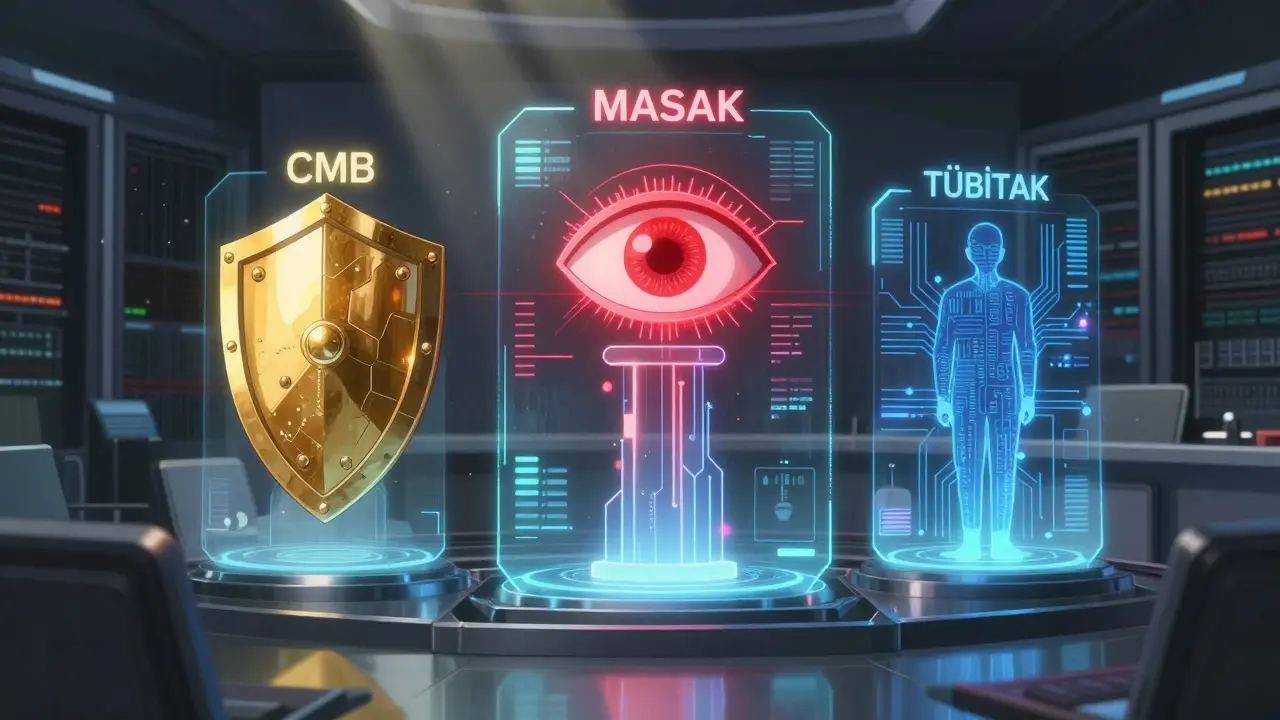
Turkey’s approach is unique because it doesn't rely on a single agency. Instead, it uses a tri-party structure that covers legal, financial crime, and technical aspects. Knowing which body does what helps you understand why certain actions trigger specific consequences.
| Agency | Full Name | Primary Role |
|---|---|---|
| CMB | Capital Markets Board | Licensing exchanges, setting operational rules, imposing sanctions. |
| MASAK | Financial Crimes Investigation Board | Enforcing Anti-Money Laundering (AML) laws, freezing suspicious accounts. |
| TÜBİTAK | Scientific and Technological Research Council of Türkiye | Verifying technical infrastructure and security standards of platforms. |
The CMB acts as the gatekeeper. If you don't have their license, you aren't allowed to operate. MASAK acts as the police. They monitor transactions for illicit activity and have broad powers to freeze funds. TÜBİTAK ensures the technology behind these platforms is secure and meets national standards. This separation of duties creates a net that is difficult for bad actors to slip through.
The Payment Ban: What You Can and Cannot Do
Here is the most critical restriction for everyday users: You cannot use cryptocurrency to pay for goods or services in Turkey.
This rule was established back in April 2021 by the Central Bank of Turkey (TCMB), but it remains a central pillar of the current framework. While you can legally buy, sell, and hold Bitcoin, using it to buy coffee, pay rent, or settle business invoices is illegal. The government views cryptocurrencies as speculative assets, not currency. Their goal is to protect the monetary sovereignty of the Turkish lira.
Why does this matter? Because it limits the utility of your holdings. In countries like El Salvador or even parts of the EU, you might find merchants accepting crypto. In Turkey, if a merchant accepts Bitcoin, they are breaking the law. This also impacts remittances. Sending money abroad via stablecoins to bypass traditional banking channels is heavily scrutinized. Authorities view such moves as potential capital flight, which threatens economic stability.
Enforcement in Action: The 2025 Crackdown
Laws on paper mean little without enforcement. Throughout 2025, Turkish authorities demonstrated exactly how seriously they take this framework. The escalation was rapid and decisive.
In February 2025, full Anti-Money Laundering (AML) rules went into effect. This wasn't just about checking IDs once during sign-up. It required ongoing audits and strict reporting. By July 2025, the intensity increased dramatically. Authorities blocked access to 46 unlicensed exchanges within a short period. This list included major decentralized exchange (DEX) platforms like PancakeSwap. For users accustomed to self-custody and non-custodial trading, this was a shock. Accessing these protocols became technically difficult due to internet filtering.
The crackdown also had political dimensions. On July 28, 2025, the founder of ICRYPEX, a prominent local exchange, was detained. Allegations linked the platform's funding to government critics. Whether viewed as a standard financial crime investigation or a political move, the message was clear: operating outside the licensed framework carries severe personal risks, including detention.
Impact on Traders and Users
How does this affect you if you live in Turkey or trade with Turkish residents? The experience has shifted from convenience to compliance-heavy friction.
KYC is Non-Negotiable: Identity verification is mandatory. For transactions exceeding 15,000 Turkish lira (roughly $425-$450), you must provide detailed documentation explaining the source of funds. This aligns with Financial Action Task Force (FATF) recommendations but feels intrusive to many users. Expect delays. Account verification processes on licensed exchanges can take weeks as staff manually review documents to avoid MASAK penalties.
Limited Platform Choice: With high capital requirements, only large, well-funded companies can afford licenses. This reduces competition. Prices may be less competitive, and customer service might suffer due to monopolistic tendencies. However, consumer protection is stronger. Licensed exchanges are required to maintain segregated client funds and undergo regular audits.
Migration Risks: Many users tried to migrate to international platforms to avoid these rules. However, Turkish authorities actively block domains of unlicensed foreign exchanges. Using VPNs to bypass these blocks is technically possible but legally risky. If MASAK detects suspicious cross-border flows, they can freeze both your crypto wallets and your traditional bank accounts linked to those activities.

Comparison with Global Standards
To understand Turkey's position, it helps to compare it with other major jurisdictions. Turkey’s model is distinct.
- vs. European Union (MiCA): Turkey’s framework mirrors the EU’s Markets in Crypto-Assets (MiCA) regulation in its comprehensiveness. Both require licensing and AML compliance. However, Turkey is stricter on payments. MiCA allows member states to decide on payment usage, while Turkey bans it outright.
- vs. United States: The US has a fragmented system with the SEC, CFTC, and IRS all claiming jurisdiction. Turkey centralizes power under the CMB. This provides clearer guidelines for businesses but concentrates risk if the regulator makes errors.
- vs. China: China banned crypto entirely. Turkey allows trading but restricts usage. This makes Turkey more open than China but far more restrictive than most Western nations.
- vs. Switzerland: Switzerland is known for being crypto-friendly with low barriers to entry. Turkey’s high capital requirements ($4.1M+) make it much harder for startups to launch there.
What Comes Next?
The regulatory tightening shows no signs of stopping. As of mid-2026, the government is drafting additional legislation to expand MASAK’s powers. Key proposals include:
- Broader Freezing Authority: Allowing MASAK to freeze crypto accounts without prior court approval in cases of suspected financial crimes.
- Stablecoin Restrictions: Tighter controls on stablecoin transfers to prevent unregulated capital flight.
- Enhanced Reporting: Mandatory real-time reporting of large transactions to regulators.
These measures aim to align Turkey fully with international anti-money laundering standards. For businesses, this means investing heavily in compliance infrastructure. New entrants face a steep learning curve, often taking 6-12 months to achieve full compliance. A consulting industry has emerged around Turkish crypto compliance, offering premium advisory services to help navigate the complex legal landscape.
Despite these restrictions, the market remains vibrant. Over 20% of the population owns digital assets. Licensed exchanges are capturing increasing market share as unlicensed alternatives are blocked. The future of crypto in Turkey is regulated, monitored, and tightly controlled. It is no longer a frontier for wild speculation, but a structured financial sector with strict guardrails.
Is it illegal to own cryptocurrency in Turkey?
No, owning cryptocurrency is legal in Turkey. You can buy, sell, and hold digital assets like Bitcoin and Ethereum. However, you must do so through licensed platforms approved by the Capital Markets Board (CMB). Trading on unlicensed exchanges is prohibited and can lead to account freezes or legal action.
Can I use Bitcoin to pay for groceries in Turkey?
No, using cryptocurrency to pay for goods or services is strictly illegal in Turkey. The Central Bank of Turkey (TCMB) banned crypto payments in 2021 to protect the Turkish lira's monetary sovereignty. Merchants who accept crypto risk heavy fines and closure. Cryptocurrencies are treated solely as speculative investment assets.
What happens if I trade on an unlicensed exchange?
Trading on unlicensed exchanges is risky. Authorities actively block access to these platforms, as seen in the July 2025 crackdown where 46 sites were blocked. Additionally, the Financial Crimes Investigation Board (MASAK) can freeze your bank accounts if they detect transactions linked to unlicensed entities. You also lose consumer protections, meaning if the exchange fails or gets hacked, you have no legal recourse.
Do I need KYC to trade crypto in Turkey?
Yes, Know Your Customer (KYC) verification is mandatory on all licensed exchanges. For transactions over 15,000 Turkish lira, you must provide extensive documentation proving the source of your funds. Failure to comply can result in suspended accounts and reports to MASAK for potential money laundering investigations.
How does Turkey's crypto regulation compare to the EU?
Turkey's framework is similar to the EU's MiCA regulation in terms of licensing and AML requirements. However, Turkey is more restrictive regarding payments. While the EU allows some flexibility for crypto payments depending on the member state, Turkey completely bans them. Turkey also has higher capital requirements for exchanges compared to many EU jurisdictions.
What is the role of MASAK in crypto regulation?
MASAK (Financial Crimes Investigation Board) is responsible for enforcing anti-money laundering laws. They monitor crypto transactions for suspicious activity, such as large, unexplained transfers or links to illicit networks. MASAK has the power to freeze crypto wallets and associated bank accounts without prior court approval in urgent cases, making them a powerful enforcement tool.
Are decentralized exchanges (DEXs) legal in Turkey?
Using decentralized exchanges is highly restricted. While the code itself may exist globally, accessing DEX platforms like PancakeSwap is often blocked by Turkish internet providers. Authorities consider unlicensed platforms illegal. Users attempting to access them via VPNs risk having their connections throttled or their accounts flagged by MASAK for suspicious behavior.