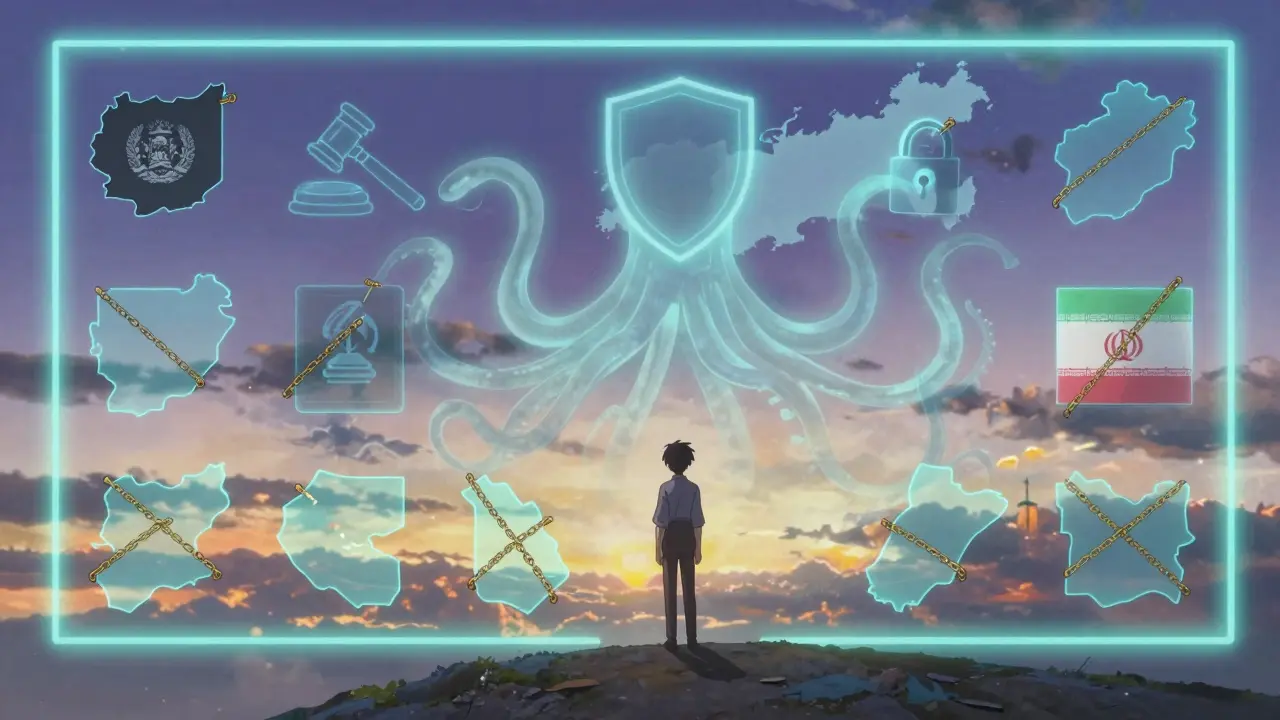
If you're trying to trade crypto on Kraken and hit a wall-whether it's a message saying "Service not available" or you can't deposit USDT in Europe-you're not alone. Kraken blocks trading in 14 full jurisdictions and imposes dozens of specific rules across dozens more. This isn't about technical glitches. It's about compliance. And if you want to use Kraken, you need to know exactly what’s allowed and where you’re locked out.
Full Country Bans: Where Kraken Doesn't Operate
Kraken outright refuses to serve users in 14 countries and regions due to international sanctions. These aren't arbitrary. They match U.S., EU, and UN sanctions lists. If you're in any of these places, you won't get past the login screen:
- Afghanistan
- Belarus
- Russia (including Crimea, Donetsk, and Luhansk)
- Iran
- Iraq
- North Korea
- Syria
- Libya
- Sudan
- South Sudan
- Democratic Republic of the Congo
- Cuba
- Central African Republic
- Eritrea
That’s just the start. Kraken also restricts services in another 15+ regions like Lebanon, Mali, Somalia, and Yemen. Why? Because those places have weak anti-money laundering controls, or are under active sanctions. Kraken doesn’t make these decisions lightly-they’re tied to global legal frameworks enforced by FinCEN, the FCA, and other regulators.
U.S. Restrictions: It’s Not Just One Country
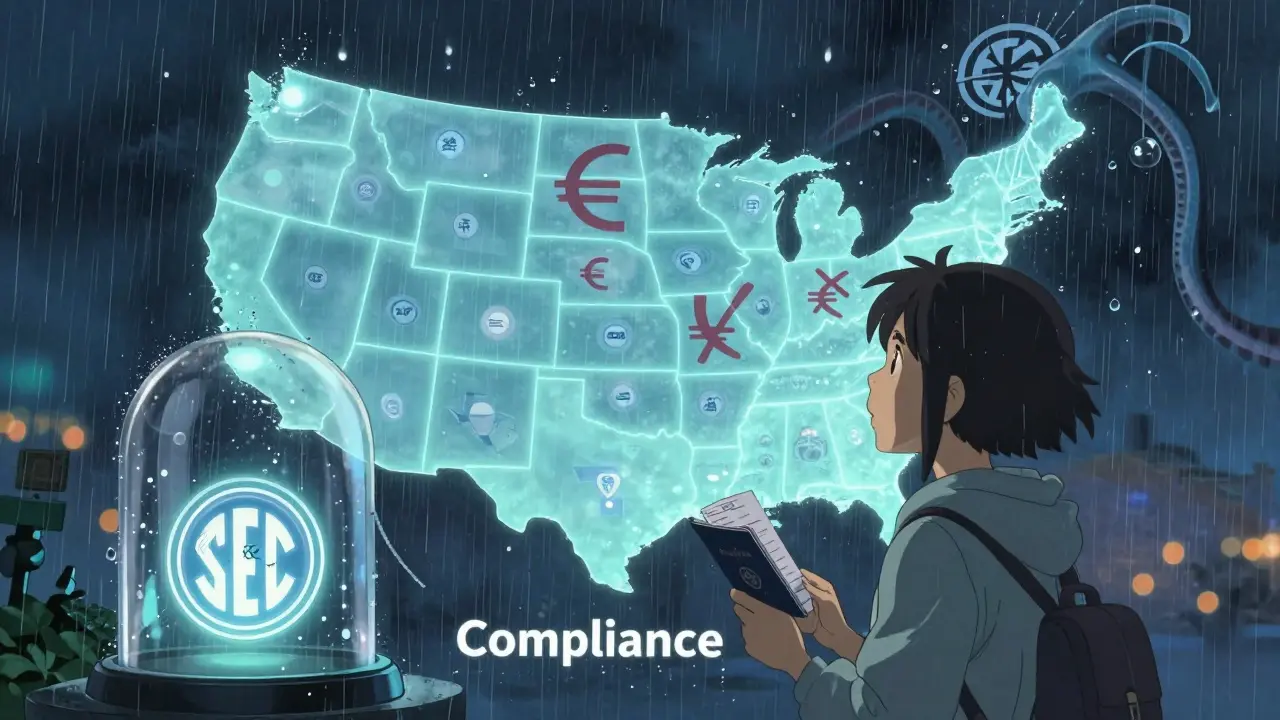
If you’re in the U.S., you’re not off the hook. Kraken treats each state like its own country. Here’s what you can’t do:
- Everyone in the U.S.: Can’t trade XRP. Ever. This is because the SEC considers it a security, and Kraken won’t risk a lawsuit.
- New York and Washington State: You can’t open a standard account. Only pre-verified users with special approval can access limited features.
- New Hampshire and Texas: You can’t hold or trade Euros on Kraken. No EUR deposits, no EUR pairs.
- Everyone in the U.S. and Canada: Can’t trade EWT, GRT, or FLOW tokens. These are restricted due to regulatory uncertainty.
- ETH2.S: You can only stake it. No direct buying or selling.
- Margin trading: Max 28 days. In Europe or Asia? You can hold positions for a full year.
Why such chaos? Because U.S. crypto regulation is a patchwork. The SEC, CFTC, and state regulators all have different rules. Kraken chose to lock down access rather than risk fines. In 2022, they paid a fine for sanctions violations. In 2023, the SEC sued them over unregistered trading-then dropped the case. Still, they play it safe.
Europe’s Big Change: USDT Is Gone
In early 2025, Kraken made a major move: they started delisting five major stablecoins across the European Economic Area. This includes Tether (USDT), PayPal USD, TrueUSD, Tether EURt, and TerraClassic USD. Here’s the timeline:
- February 13, 2025: Reduce-only mode (you can only sell, not buy)
- February 27, 2025: Sell-only mode (no new deposits)
- March 17, 2025: Close all margin positions
- March 24, 2025: Spot trading ends
- March 31, 2025: Final conversion or withdrawal deadline
This affects over 30 countries including Austria, Spain, Sweden, Portugal, Malta, and Czechia. Why? MiCA-the EU’s new crypto law-requires strict asset oversight. Kraken says USDT doesn’t meet the new standards. Even though Tether is the most traded stablecoin globally, Kraken chose compliance over convenience.
Users are furious. Many say they had no warning. Others are scrambling to move funds to other platforms. But Kraken’s stance is clear: they won’t risk their EU license.
Australia and Japan: Privacy Coins and Paperwork
Australian users can’t trade privacy coins at all. That means:
- Monero (XMR)
- DASH
- Zcash (ZEC)
These are banned because Australian regulators consider them high-risk for money laundering. No exceptions. No appeals.
Japanese users face different hurdles. To trade JPY, you need extra documentation. Kraken requires proof of address, tax ID, and sometimes even bank statements. It’s not unusual for Japanese accounts to take 5-7 days to verify. Why? Japan’s Financial Services Agency (FSA) demands strict identity checks for all crypto exchanges.
How Kraken Knows Where You Are
You can’t trick Kraken with a VPN. The system checks:
- Your IP address
- Government ID (passport, driver’s license)
- Proof of residence (utility bill, bank statement)
- Transaction patterns
If you try to log in from a blocked country-even if your ID says you’re in Canada-you’ll get locked out. And if you’re caught using a VPN, your account gets suspended. Assets may be frozen. No warning. No second chance.
Kraken says this isn’t punishment-it’s protection. They’ve been fined before. They’ve had accounts shut down by regulators. Now, they automate compliance. It’s strict. But it’s consistent.
Why Kraken Does This (And Why It Matters)
Kraken isn’t trying to be annoying. They’re trying to survive. In 2020, they became the first crypto exchange to get a U.S. banking license in Wyoming. That’s huge. It means they’re treated like a bank-subject to federal oversight, audits, and capital requirements.
That license is worth billions. Losing it would kill the company. So they block Russia, ditch USDT in Europe, and lock down U.S. states. They’re not choosing between users and regulators-they’re choosing to stay in business.
Other exchanges? Some don’t check locations. Some let you trade XRP. Some still list privacy coins. But those platforms get shut down. Kraken’s model is simple: play by the rules, even when they’re messy.
Analysts say this strategy is paying off. Kraken is the fourth-largest exchange by volume. Institutional investors trust them. Banks partner with them. That’s not luck-it’s compliance.
What’s Next?
Kraken’s restrictions aren’t permanent. They change as laws change.
- New York and Washington State might get full access if regulators approve.
- Staking for more tokens could return if SEC rules soften.
- Europe might see some stablecoins return if MiCA evolves.
But don’t expect quick changes. Kraken moves slowly. They wait for regulators to speak. Then they act. That’s the price of being one of the few compliant giants.
Can I still use Kraken if I live in a blocked country?
No. Kraken blocks access at the IP and ID level. Even if you use a VPN, your account will be flagged and frozen. Attempting to bypass restrictions violates their terms and can result in permanent loss of funds.
Why can’t I trade XRP on Kraken even though it’s legal in my country?
The SEC considers XRP a security, and Kraken operates under U.S. law. Even if you’re outside the U.S., Kraken applies the restriction globally to avoid legal risk. This is why XRP is blocked for all users, regardless of location.
What happens to my USDT after March 31, 2025, in Europe?
After March 31, 2025, USDT and the other delisted stablecoins will no longer be tradable on Kraken. You can withdraw them before then, or they’ll be automatically converted to EUR or USD at the exchange rate at the time of closure. Any remaining balance after the deadline will be locked.
Can I open a Kraken account if I’m a U.S. citizen living abroad?
Possibly. Kraken uses your current location, not your citizenship. If you live in a permitted country and provide proof of residence there, you can open an account. But you must still follow local restrictions-for example, U.S. citizens in Germany still can’t trade XRP.
Does Kraken plan to lift any restrictions in 2026?
Kraken hasn’t announced any plans to lift restrictions in 2026. Their policy is to wait for regulatory clarity. If New York or Washington State approves new crypto rules, Kraken may reconsider. But don’t expect changes unless regulators move first.
Final Thought: Compliance Isn’t Perfect-But It’s Reliable
Kraken’s restrictions are frustrating. They’re confusing. They change without warning. But they’re also predictable. You know what’s banned. You know why. And you know the consequences of trying to cheat the system.
For most users, this isn’t about freedom. It’s about safety. Kraken doesn’t have the same risks as unregulated platforms. No sudden shutdowns. No frozen funds from legal raids. If you want a crypto exchange that won’t vanish tomorrow, Kraken’s strict rules are a feature-not a bug.
Molly Andrejko
February 7, 2026 AT 12:24I appreciate how Kraken is being proactive about compliance-even if it’s frustrating, it’s better than getting shut down overnight. I’ve seen too many platforms disappear after a regulatory crackdown, and I’d rather lose access to a few tokens than lose everything. It’s not perfect, but it’s the least risky option out there.
Michael Sullivan
February 9, 2026 AT 12:07Let’s be real-this isn’t compliance, it’s cowardice. 🤦♂️ Kraken could’ve fought the SEC on XRP. They chose to roll over instead. Now they’re just a glorified ATM with a 14-country ban list. I’m switching to Binance. At least they let me trade what I want.
perry jody
February 9, 2026 AT 15:45Yessss! Finally an exchange that actually follows the rules! 🙌 I’m tired of sketchy platforms that vanish overnight. Kraken’s being cautious, not cruel. And hey-if you’re in a banned country, maybe that’s a sign to move somewhere less sketchy? Just saying.
Paul Jardetzky
February 11, 2026 AT 11:32USDT delisting in Europe? Totally expected. MiCA is a game-changer, and Kraken’s being smart. Tether’s balance sheet is still a black box. I’d rather lose liquidity than risk my portfolio on unregulated stablecoins. This is the future-transparency or bust.
Paul Gariepy
February 12, 2026 AT 07:31So Kraken blocks XRP everywhere because of the SEC? That’s wild. I live in Germany, I’m not even a U.S. citizen, and I can’t trade it? Why do they apply U.S. rules globally? It’s like they’re scared of their own shadow. I’ve been holding XRP since 2017-I’m not happy. This feels like overreach.
Oliver James Scarth
February 14, 2026 AT 03:11It is rather striking, is it not, how Kraken has positioned itself as the ‘responsible adult’ in a room full of chaotic toddlers? The United Kingdom, for instance, has taken a far more nuanced approach to stablecoins. Yet here we are-Kraken, a company that once prided itself on innovation, now acting as an extension of FinCEN’s bureaucracy. One wonders if the soul of crypto has been sacrificed on the altar of regulatory appeasement.
Kieren Hagan
February 14, 2026 AT 23:36Let’s not romanticize this. Kraken isn’t ‘protecting’ users-they’re protecting their balance sheet. They got fined for sanctions violations. Now they’re overcorrecting. The fact that they block EUR trading in Texas is absurd. That’s not compliance-that’s incompetence disguised as caution. If you’re going to operate globally, you need better systems.
sachin bunny
February 16, 2026 AT 12:43Bro this is all a CIA plot. 🤫 They want to control crypto so they can track EVERYONE. USDT gone? XRP blocked? That’s not regulation-that’s a prelude to CBDC takeover. You think they care about AML? Nah. They just want to kill decentralization. Wake up.
Olivette Petersen
February 18, 2026 AT 12:05I get why Kraken does this, honestly. I used to trade on an unregulated exchange and lost funds when it got raided. This time, I’d rather have rules-even if they’re annoying. It’s like wearing a seatbelt. Annoying? Yes. Worth it? Absolutely.
Michelle Anderson
February 19, 2026 AT 08:56Ugh. Another ‘compliance porn’ post. Kraken’s not a hero-they’re a liability-averse corporation with a PR team. They’re not ‘saving’ crypto. They’re just the last standing corpse in a graveyard of failed exchanges. And now they’re charging you extra for the coffin.
Danica Cheney
February 21, 2026 AT 00:33so like... why even use kraken then?
Kyle Pearce-O'Brien
February 21, 2026 AT 07:41Let’s be candid: Kraken’s compliance architecture is a masterclass in corporate self-preservation masquerading as ethical stewardship. The delisting of USDT? A performative act of regulatory theater. The global application of U.S. securities law? A hegemonic overreach disguised as risk mitigation. We’re witnessing the ossification of crypto’s libertarian promise into a regulated, institutionalized, and ultimately, soulless financial infrastructure.
Matthew Ryan
February 22, 2026 AT 11:56I’ve been on Kraken since 2020. I’ve had my ups and downs, but I’ve never lost funds. I’d rather wait for XRP to be cleared than gamble on some shady alt-exchange. I get the frustration, but I trust this more than any other platform.
Nathaniel Okubule
February 22, 2026 AT 20:25For those upset about the USDT delisting: Kraken provided a clear timeline, multiple warnings, and options to withdraw or convert. That’s more than most exchanges do. If you’re angry, channel it into pushing for better regulations-not abandoning compliance entirely.
Shruti Sharma
February 23, 2026 AT 03:08my friend in india cant trade xmr on kraken but she can on binance... why even bother with kraken then? they make it so hard and then act like theyre the good guys??