
Finding a free token distribution can feel like winning a digital lottery, but the Jswap airdrop is a bit more complicated than your average giveaway. If you've seen JF tokens popping up in your wallet or you're hunting for a way to get them, you're likely looking at a project that once promised a massive DeFi empire on the OKExchain. While the initial hype was huge, the reality of the JF token today is a cautionary tale about liquidity and market volatility.
| Attribute | Value |
|---|---|
| Max Supply | 100 Million JF |
| Primary Ecosystem | OKExchain |
| Key Features | Swap Mining, Liquidity Pools, DAO Dividends |
| Market Status | High Risk / Low Liquidity |
What is Jswap.Finance?
Before chasing the tokens, you need to understand the machine behind them. Jswap.Finance is a decentralized exchange (DEX) and financial management protocol designed to offer a one-stop shop for DeFi services. It launched with the goal of simplifying how users interact with liquidity mining and token swaps, specifically targeting the OKExchain ecosystem.
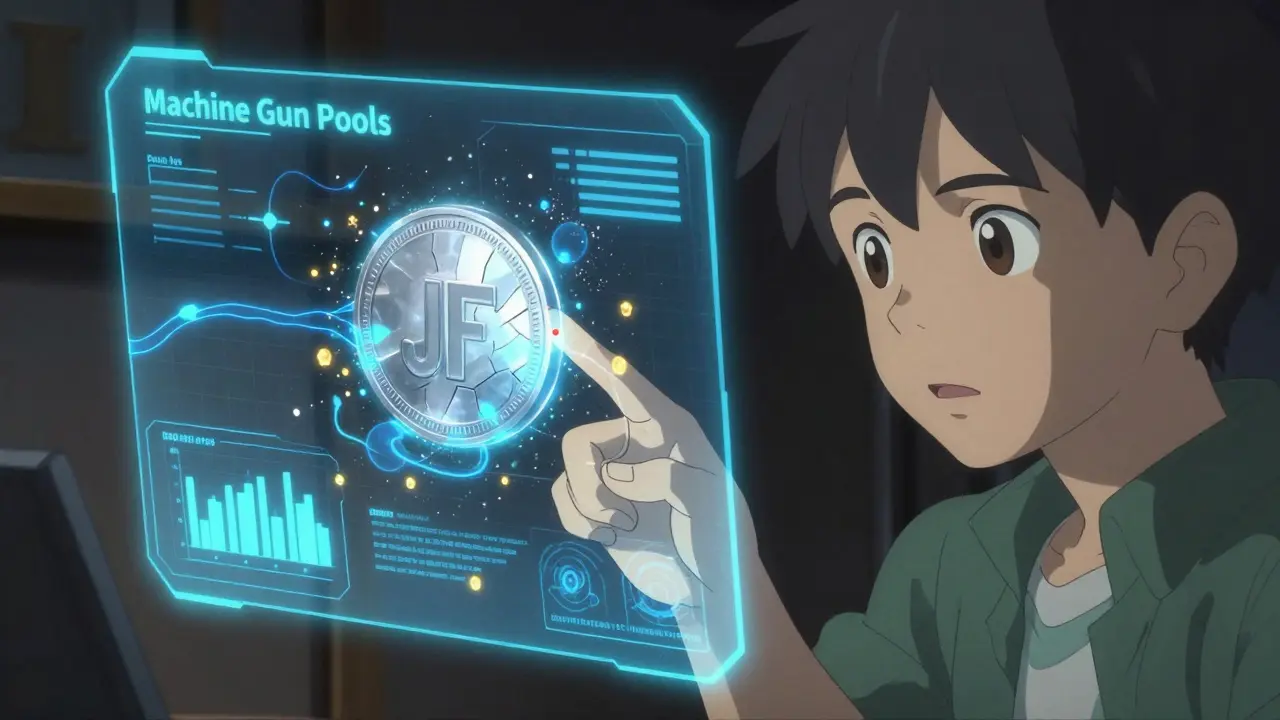
The platform isn't just about trading. It introduced "machine gun pools," which are essentially single-token vaults that let users earn yields without needing to pair their assets. They also built a DAO dividend system, meaning holders of the JF token (the native governance token) were supposed to share in the platform's success. To keep the token value up, Jswap implemented a deflationary model where profits are used to buy back and destroy JF tokens, theoretically reducing the supply and pushing prices higher.
How the JF Airdrop Worked
You won't find a simple "click here to claim" button for the Jswap airdrop. Instead, the project distributed tokens through strategic partnerships and activity-based rewards. If you're wondering how people actually got these tokens, it usually happened in one of three ways:
- Exchange Kickstarters: The most notable event happened in November 2021 via the MEXC exchange. Users didn't just sign up; they had to commit MX tokens to vote for the JF listing. In this case, over 23 million MX tokens were contributed, and the exchange distributed a total of 35,200 JF tokens as a reward to the participants.
- Promotional Challenges: Platforms like Bitget offered airdrops through ongoing challenges. Users completed specific trading tasks or joined promotions to earn rewards that were then convertible into JF tokens.
- Liquidity Mining: Early adopters who provided liquidity to the JF/USDT pairs were essentially "airdropping" tokens to themselves via massive yields. At one point, some pools boasted an Annual Percentage Yield (APY) of over 1,400%, though these numbers are often unsustainable in the long run.
The Reality Check: Current Market Value
Here is where things get tricky. If you've managed to snag some JF tokens, you might notice something strange when checking your portfolio. On major tracking sites like CoinMarketCap and Binance, the current price of JF is frequently listed as $0 USD. This doesn't necessarily mean the token is deleted from existence, but it indicates a severe lack of liquidity.
Trading volume has effectively vanished. For example, some data points show 24-hour decentralized exchange volume as low as $40. When there is no one buying and no one selling, the price feed breaks, and the value drops to zero. If you see a "NaN" (Not a Number) for the All-Time High, it's a sign that the data providers have essentially given up on tracking the asset due to inactivity.
Potential Risks and Red Flags
Entering a project like Jswap today requires an extreme level of caution. Most airdrop hunters ignore the "Innovation Zone" warnings on exchanges, but those warnings are there for a reason. When a token's market cap hits $0 and the trading volume is non-existent, you are dealing with a "ghost chain" scenario.
The deflationary model (buying back and burning tokens) only works if the platform is making a profit. If the DEX isn't processing trades, there are no profits to fuel the burn. This creates a death spiral: no users leads to no profit, which leads to no token burns, which leads to a crashing price, which further discourages users.
How to Handle Your JF Tokens
If you are currently holding JF tokens from a previous airdrop, you have a few options, though none are guaranteed to be profitable:
- Check the Original Exchange: If you earned them via MEXC or Bitget, check if those specific pairs are still active for trading. Sometimes a token is dead on global trackers but still has a tiny bit of movement on the exchange that listed it.
- Verify the Contract: Ensure you are looking at the correct contract address (starting with 0x5fAc...C85b0A) to avoid falling for "scam clones" that pretend to be Jswap to steal your gas fees.
- Treat it as a Loss: In the current climate, with a fully diluted market cap that contradicts a $0 spot price, the safest bet is to assume the tokens have no monetary value.
Can I still get the Jswap airdrop today?
While some platforms like Bitget have mentioned ongoing rewards, there is no official, active airdrop currently running from the Jswap.Finance team. Most distributions happened during the 2021 launch period. Be very wary of any website asking for your seed phrase to "claim" a Jswap airdrop; these are almost certainly scams.
Why is my JF token showing a price of $0?
A $0 price usually means there is zero trading volume on the exchanges being tracked. If no one is buying or selling the token, the price feed cannot find a current market rate, resulting in a zero value on sites like CoinMarketCap.
What is the purpose of the JF token?
The JF token was designed as a governance and utility token for the Jswap.Finance ecosystem. It allows holders to participate in DAO dividends and is used within the platform's liquidity mining and swap mining processes.
Is Jswap.Finance safe to use?
Given the current market data-including zero trading volume and a price of $0-the project is considered extremely high-risk. Any funds deposited into their liquidity pools may be difficult to withdraw or could lose significant value due to the token's instability.
What happened to the OKExchain integration?
Jswap launched specifically to leverage the speed and low cost of the OKExchain. However, as the broader ecosystem evolved and liquidity shifted, many early projects on the chain struggled to maintain active user bases, which is reflected in Jswap's current lack of volume.
Eric Raines
April 21, 2026 AT 20:39Typical DeFi garbage. Everyone fell for the "machine gun pools" gimmick and now they're shocked that the liquidity just vanished into thin air. I've been saying since 2021 that any project relying solely on a single exchange chain like OKExchain is basically just a fancy way to lose money fast. It's not even a "cautionary tale," it's just basic math. If there's no actual utility outside of a circular reward system, the price is always going to hit zero eventually. People love to chase these airdrops without understanding that if the token isn't being used for anything real, it's just a digital pebble.
Larry Yang
April 21, 2026 AT 22:34imagine actually thinkin a deflationary model works when there's no organic volume. its literally high school economics lol. the whole thing was a poorly designed pump and dump disguised as an ecosystem. honestly, the fact that people are still checkin the contract for "scam clones" is the funniest part because the original project is already a ghost town. totally pathetic.
Yvette P
April 23, 2026 AT 21:15Oh, look at us, pretending that a 1,400% APY in a liquidity pool isn't just a flashing neon sign screaming "I AM A PONZI SCHEME" to anyone with a functioning brain.
The slippage on those pairs must have been absolutely astronomical by the time the exit liquidity dried up, leaving the late-comers holding bags of JF that are essentially worthless since the order books are completely hollowed out. It's truly fascinating how people mistake "innovation zone" for "opportunity zone" when the underlying smart contract is basically a vacuum for capital. You've got a classic death spiral here where the tokenomics were built on a foundation of sand, and now that the tide has gone out, we're all just staring at the wreckage of a project that had zero fundamental value. If you're still trying to find a way to trade this on an obscure exchange, you're not investing, you're just donating your gas fees to the network validators for a little bit of dopamine. Maybe next time we can try projects that actually have a product instead of just a whitepaper full of buzzwords like "DAO dividends" and "automated yield optimization." Just a thought for those of you who enjoy losing money in the most inefficient way possible.
Doc Coyle
April 24, 2026 AT 04:42It is simply wrong to encourage people to hunt for these airdrops when they clearly lead to financial ruin.
Ellie Drews
April 25, 2026 AT 11:52Let's just be kind to everyone who got caught up in the hype. It's a learning experience for all of us. Maybe we can share some better ways to research projects so nobody else loses their savings.
Jagdish Sutar
April 26, 2026 AT 02:19I completely agree with the sentiment of helping others. It's always better to guide new investors toward safer options and sustainable growth rather than high-risk gambles.
Findlay Duncan Lyon
April 27, 2026 AT 01:43Absolute shambles.
Guy Bianco
April 28, 2026 AT 18:04It is unfortunate to see such a project fail. 😔 I would suggest that anyone feeling discouraged by this loss should take a moment to study the fundamentals of blockchain technology. Knowledge is the best hedge against volatility. 📚
Paige Raulerson
April 30, 2026 AT 08:27I can't believe we're even discussing this. It's so incredibly tedious to read through a guide for a token that has been dead for years. The lack of basic financial literacy in the crypto space is honestly exhausting. I'm just here to see how many more people actually tried to "claim" this through a seed phrase scam.
Matthew Morse
May 2, 2026 AT 06:16who even cares at this point the money is gone just delete the wallet and move on
Kyle Bush
May 3, 2026 AT 06:07USA TO THE MOON! 🇺🇸🚀 This is why you stick to the big coins and ignore this trash! Who cares about Jswap when we have real power? 🦅🔥 Get rid of the junk and buy some real assets! 💰💰💰
debashish sahu
May 4, 2026 AT 21:59It is a very sad situation when people lose their hard earned money in these schemes. We must be more careful about where we put our trust in the digital world.