
Back in 2020, if you downloaded a random app on your phone and started earning free cryptocurrency just for letting it track your location, you weren’t alone. Thousands of people did exactly that with GEOCASH - the token behind GeoDB’s airdrop campaign. It sounded too good to be true: get paid for your data. But what actually happened? And where are those tokens now?
How the GeoDB Airdrop Actually Worked
The GeoDB airdrop wasn’t some mysterious giveaway. It was a straightforward mobile app promotion. You downloaded the GeoDB app - available on Android and iOS - created a wallet inside it, and started earning GEO tokens daily just by keeping the app open. No mining rigs. No complex setup. Just your phone, location services enabled, and a few minutes a day. But here’s the catch: you didn’t earn tokens just by having the app. You had to actively participate. The app tracked your movement patterns, Wi-Fi connections, and even app usage - all data that big tech companies normally sell for billions. GeoDB promised to flip that model. Instead of Google or Apple profiting, you did. To boost participation, they added a referral system. If you invited friends using your unique code - like MDHALIM759_PXGYZQ - you got bonus tokens for every person who signed up. Some regional promotions offered extra incentives. For example, in India, users could claim 10 free GEO tokens on Bitforex, but only if they were among the first 2,000 to join. The whole thing felt like a game. Open the app. Tap ‘Claim’. Invite three friends. Get more tokens. It was designed to be addictive, and for a while, it worked.What Was GEO Token Even For?
GEO was built as an ERC-20 token on Ethereum. That meant it could be stored in any wallet that supported Ethereum standards - MetaMask, Trust Wallet, even hardware wallets. The total supply was capped at 350 million GEO. By the end of the airdrop, about 313 million were created, but only around 82 million were circulating. That’s because a big chunk was locked up for team members, investors, and future development. GeoDB claimed GEO tokens would be used to pay for data on their platform. Imagine a future where advertisers bid for your location data, and you get paid in GEO. You’d use those tokens to buy premium features, access exclusive analytics, or even trade them on exchanges. It was a closed-loop economy: users generated data, got paid in GEO, and spent GEO back into the system. But here’s the reality: that economy never really took off. The app never became a marketplace for data. It stayed a reward tracker.The Wallet: Wallace Wallet and the Shift to ODIN Chain
As the project evolved, GeoDB quietly rebranded its user interface into something called Wallace Wallet. This wasn’t just a name change. It was a full technical overhaul. The original app still worked, but new users were directed to Wallace Wallet - a cleaner, more secure interface with better wallet management tools. Then came the big move: migration from Ethereum to ODIN Chain. ODIN Chain was a new blockchain built specifically for data monetization. The idea was simple: lower fees, faster transactions, and better scalability for micro-payments. But this migration came with risks. If you didn’t claim your tokens before the cutoff, you could lose them. Many users missed the window. Others didn’t understand the upgrade. Today, if you check CoinMarketCap or CoinGecko, you’ll see GEO trading at around $0.0001664. That’s not zero - but it’s close. The 24-hour trading volume? Just $120. That’s less than what some people spend on coffee in a week. Most trades happen on Uniswap V2, but liquidity is thin. The last recorded trade? Two days ago. That’s not a market. That’s a graveyard with a few curious visitors.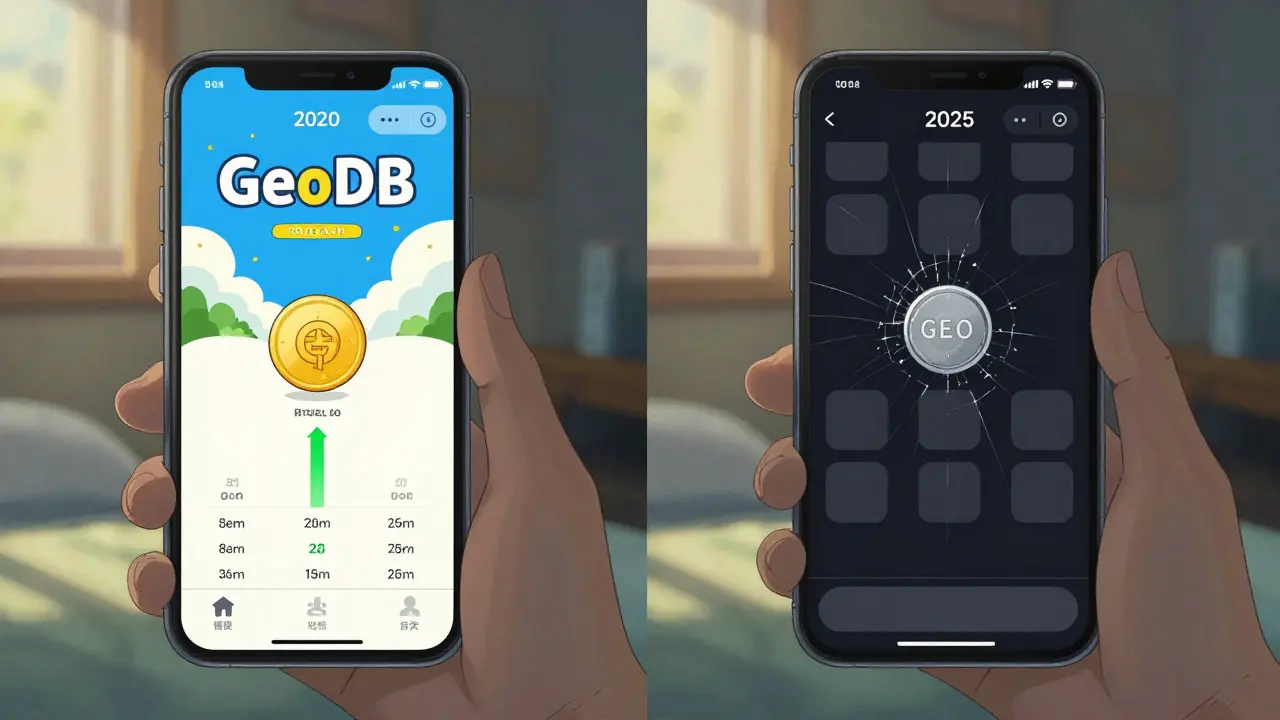
Why Did the GEO Airdrop Fizzle Out?
There are a few reasons why this didn’t become the next Bitcoin. First, the earning potential was exaggerated. Early promotional videos promised users could earn $5 a day. That was never realistic. Most people got pennies - maybe 5-10 GEO per day. At today’s price, that’s less than a cent. Not worth the battery drain or privacy trade-off. Second, the app itself was clunky. It drained battery. It asked for location access constantly. It didn’t offer clear value beyond the tokens. People didn’t feel like they were part of a revolution - they felt like they were running a background process that did nothing useful. Third, the community faded. Telegram groups went quiet. YouTube videos stopped being updated. The team shifted focus to ODIN Chain and Wallace Wallet, leaving the original airdrop users behind. There were no major updates, no roadmap releases, no transparency. And finally - and this is critical - no one really needed GEO. There was no real use case. No dApps. No DeFi integrations. No NFT marketplace. Just a token with nowhere to go.What Happens If You Still Have GEO Tokens?
If you still have GEO tokens in your wallet - whether from the airdrop or later purchases - here’s what you can do:- Check if your wallet is compatible with ODIN Chain. If not, you’ll need to bridge your tokens using the official GeoDB migration tool.
- Don’t delete the Wallace Wallet app. It’s the only place where you can manage your tokens safely.
- Don’t expect to cash out. There’s no exchange where GEO has real liquidity. Even if you sell, you’ll get almost nothing.
- Hold onto your private key. Always. If you lose it, you lose your tokens forever.

Is There Any Value Left in GeoDB or GEO?
Technically? Maybe. The idea of paying users for their data is still valid. Companies like Helium and Brave have proven you can build models around user-owned data. But GeoDB didn’t execute. They built a token without a system. They created a wallet without a purpose. If you’re looking to earn from your data today, there are better options. Brave offers BAT for browsing. Honeygain pays you for unused bandwidth. Even some newer blockchain projects offer more transparent, active ecosystems. GEO’s story isn’t a failure of technology. It’s a failure of vision. They had a great concept - give people control over their data - but they turned it into a marketing gimmick instead of a real platform.What You Can Learn From the GEO Airdrop
This isn’t just about one failed token. It’s a lesson in crypto hype.- Free tokens are rarely free. You pay with your privacy, your time, and your trust.
- Always ask: What’s the real use case? If the answer is ‘to trade on an exchange’, that’s a red flag.
- Check the team. Are they active? Do they release updates? Or do they vanish after the airdrop?
- Don’t chase promises of $5 a day. If it sounds too good to be true, it usually is - especially in crypto.
Was the GeoDB airdrop real or a scam?
The GeoDB airdrop was real - you did receive actual GEO tokens. But it wasn’t a scam in the traditional sense. There was no fake website or stolen funds. The problem was the lack of long-term value. The tokens had no real utility, the project stalled, and the ecosystem never grew. It was more of a failed experiment than a fraud.
Can I still claim GEO tokens from the 2020 airdrop?
No. The official airdrop campaign ended years ago. The app is no longer accepting new signups for the original rewards. If you didn’t claim your tokens back then, you can’t get them now. Any site claiming to offer ‘late airdrops’ is likely a phishing attempt.
Where can I trade GEO tokens today?
GEO is only actively traded on Uniswap V2 (Ethereum) as a GEO/WETH pair. Trading volume is extremely low - under $150 per day - and prices are nearly stagnant. Most exchanges don’t list it anymore. Don’t expect to sell for a meaningful amount.
Do I need to migrate my GEO tokens to ODIN Chain?
If you still use the Wallace Wallet, your tokens are already on ODIN Chain. If you hold GEO in a third-party wallet like MetaMask, you’ll need to use the official bridge tool from GeoDB to move them. Without migration, your tokens won’t work in the new ecosystem - but they won’t disappear either. Just remain stuck on Ethereum.
Is GeoDB still active in 2025?
Technically yes, but barely. The Wallace Wallet app still exists and can be downloaded. The ODIN Chain network is live. But there are no recent announcements, no team updates, and no community growth. The project is in maintenance mode - no new features, no marketing, no development. It’s alive, but not thriving.

Shawn Roberts
December 25, 2025 AT 14:09Used to open the app every morning like it was a game
Now it's just a digital fossil in my MetaMask
But hey at least I didn't lose my private key 😅
Abhisekh Chakraborty
December 26, 2025 AT 01:40dina amanda
December 26, 2025 AT 20:05SUMIT RAI
December 27, 2025 AT 05:19It wasn't about the money
It was about the vibe
That app was pure 2020 energy
And now we're all just ghosts haunting a dead blockchain 💀
Andrea Stewart
December 28, 2025 AT 05:45Josh Seeto
December 28, 2025 AT 23:25And now you're sad the ROI was bad?
Bro. You were the product. Always were. Welcome to capitalism with blockchain glitter on it.
Khaitlynn Ashworth
December 29, 2025 AT 04:08NIKHIL CHHOKAR
December 30, 2025 AT 23:22Jake West
December 31, 2025 AT 03:13surendra meena
January 1, 2026 AT 17:45