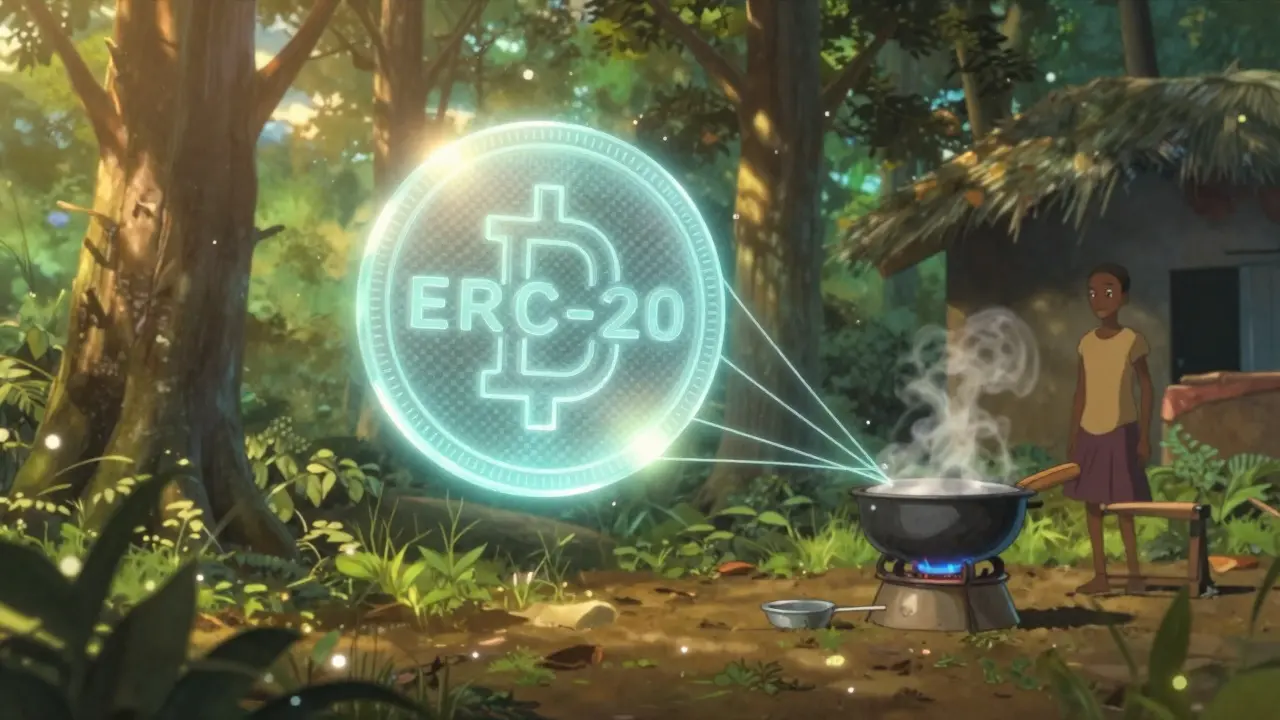
Carbon credit trading used to be slow, messy, and full of hidden risks. Companies bought credits from registries like Verra or Gold Standard, hoping the projects they paid for - like planting trees or installing clean stoves - actually reduced emissions. But how could they be sure? Credits could be counted twice. Projects could be fake. Prices were opaque. And if you weren’t a big corporation or institutional investor, you couldn’t even get in.
That’s changing - fast. Carbon credit trading on blockchain is turning old-school environmental offsets into digital tokens that can be bought, sold, and retired in seconds. It’s not just faster. It’s transparent, tamper-proof, and open to anyone with an internet connection.
How Carbon Credits Become Blockchain Tokens
Tokenization isn’t magic. It’s a three-step process that bridges the physical world of carbon reduction with the digital world of blockchain.
First, real carbon credits - each representing one ton of CO₂ removed or avoided - are locked into secure custodial accounts run by bridging platforms like Toucan Protocol or Flowcarbon. These platforms don’t create credits. They just hold verified ones from trusted registries.
Second, they mint digital tokens that match those credits 1:1. These tokens follow standard blockchain formats like ERC-20 (for divisible, fungible units) or ERC-721 (for unique, non-fungible credits). Each token carries metadata: project location, type (renewable energy? reforestation?), vintage year, and the original registry ID. This data is permanently stored on the blockchain.
Third, those tokens go live on decentralized exchanges or carbon marketplaces. You can buy a whole token. Or you can buy 0.001 of one. That’s fractional ownership - something impossible in traditional markets. When you’re done, you can retire the token with a click. The smart contract automatically updates the original registry, marking that credit as used. No more double counting. No more paperwork.
Why Blockchain Solves Carbon Market Problems
The voluntary carbon market was worth about $2 billion in 2024. Experts say it could hit $1 trillion in 15 years. But it’s stuck because of three big flaws:
- Double counting: The same credit sold to two buyers. Blockchain’s immutable ledger makes this impossible.
- Fragmented registries: Verra, Gold Standard, American Carbon Registry - each has its own system. No one talks to the others. Blockchain bridges them. A token from one registry can be traded on a platform built for another.
- Opaque pricing: Prices were set by brokers, not markets. Now, real-time data flows on-chain. You see bids, asks, and trades as they happen.
For companies trying to meet net-zero goals, this is huge. Instead of waiting weeks to verify and retire credits, they can do it in minutes using an API. Automated systems can retire credits every time a shipment is delivered or a server runs. It turns carbon accounting from a quarterly chore into a real-time process.
Public, Private, and Consortium Blockchains in Carbon Markets
Not all blockchains are the same. Three types are being used - each for different needs.
Public blockchains like Ethereum and Polygon are open to everyone. Anyone can verify transactions. All data is visible. This builds trust. That’s why most carbon token platforms use them. Transparency is the whole point.
Private blockchains are controlled by one company. Useful for internal carbon accounting. A factory might track its own emissions offsets on a private chain without exposing data to competitors.
Consortium blockchains are shared by trusted groups - say, a coalition of banks, verifiers, and NGOs. They offer privacy with accountability. Governance is distributed, so no single entity controls the system. This model is gaining traction as regulators look for ways to oversee carbon markets without stifling innovation.

Key Platforms Making It Happen
Several platforms are leading the charge:
- Toucan Protocol is the biggest bridge. It issues Basic Carbon Tonnes (BCT), which pool credits from dozens of projects into one tradable token. It’s the backbone for many other platforms.
- KlimaDAO launched in 2021 and gained attention for its bold idea: make a cryptocurrency backed entirely by carbon credits. Every KLIMA token is backed by BCT. It’s not just a trading tool - it’s a currency designed to drive demand for real climate action.
- Carbonmark focuses on corporate buyers, offering easy integration with ESG software and automated retirement workflows.
- EcoRegistry and Puro specialize in high-integrity credits from tech-based removal projects like direct air capture and biochar.
These aren’t just trading platforms. They’re building new financial instruments. You can now stake carbon tokens, lend them, or use them as collateral. The carbon market is becoming a real asset class.
The Dark Side: When Bad Credits Go Digital
Blockchain doesn’t fix bad projects. It just makes them harder to hide.
In 2023, KlimaDAO’s value crashed after it bridged 670,000 Verified Carbon Units from a project in Yingpeng, China - a facility that destroyed HFC23, a super-potent greenhouse gas. The project earned credits by doing something it would’ve done anyway - and the credits were widely criticized as low-quality. Once the truth came out, investors fled. The price of KLIMA dropped over 80% in weeks.
This wasn’t a blockchain failure. It was a quality control failure. Tokenization made the problem visible faster - which is actually good. But it also showed that blockchain alone can’t ensure environmental integrity. The real work happens before the token is minted: rigorous verification, third-party audits, and strict project criteria.
Gold Standard and other registries are now tightening rules. They’re demanding proof of additionality - that the project wouldn’t have happened without the carbon credit funding. They’re also requiring data on co-benefits: clean water, jobs, biodiversity. Blockchain can track all that - if the data is there.

The Bigger Picture: Beyond Emissions
The best carbon projects don’t just reduce CO₂. They improve lives.
Think of a clean cookstove program in rural Kenya. It cuts emissions by replacing wood fires. But it also reduces lung disease, saves women hours of collecting firewood, and protects forests. That’s impact beyond carbon.
Blockchain makes it possible to prove this. Each token can carry metadata showing not just tons of CO₂ avoided, but liters of water saved, children protected, or hectares of land preserved. Investors who care about social returns can now choose credits that align with their values - not just their balance sheet.
That’s the real promise. Tokenization isn’t just about making trading easier. It’s about making climate action more accountable, more inclusive, and more human.
What’s Next for Carbon Credit Trading on Blockchain
Regulators are watching. The EU’s Carbon Border Adjustment Mechanism and California’s cap-and-trade program are starting to consider digital credits. If they approve blockchain-based offsets, the market will explode.
More projects will move on-chain. More platforms will connect. More small investors will join. And the line between finance and climate action will blur even further.
But the key won’t be the tech. It’ll be the rules. Who verifies the projects? Who sets quality standards? Who ensures no one can game the system?
Blockchain gives us the tool. But we still need the guardrails.
Can anyone buy carbon credits on blockchain?
Yes. Unlike traditional markets that require large minimum purchases or institutional access, blockchain platforms allow anyone to buy fractional carbon credits. You can start with as little as $5. Platforms like Toucan Protocol and KlimaDAO offer user-friendly wallets and marketplaces that don’t require crypto expertise.
Are blockchain carbon credits regulated?
Not yet directly. But the underlying credits still come from approved registries like Verra or Gold Standard, which follow strict verification rules. Some governments, like the EU and California, are exploring how to recognize blockchain-based credits in official compliance systems. For now, most trading happens in the voluntary market, but regulatory clarity is expected by 2027.
What’s the difference between BCT and KLIMA?
BCT (Basic Carbon Tonnes) is a token that represents one ton of verified carbon offset. It’s a direct digital twin of a real credit. KLIMA is a cryptocurrency whose value is backed by BCT reserves. You can hold KLIMA as an investment, but its price fluctuates based on market demand. BCT is meant to be retired to offset emissions - KLIMA is meant to be held or traded.
Can blockchain prevent fraudulent carbon credits?
Blockchain prevents double-spending and ensures traceability - but it can’t verify if a project actually works. A fake reforestation project can still be tokenized if the registry approves it. That’s why quality control at the registry level matters more than ever. Blockchain makes fraud easier to detect, but not impossible to create.
Do carbon credits on blockchain expire?
Yes. Each credit has a vintage year - the year the emissions reduction occurred. Most platforms require credits to be retired within 5-10 years of issuance. Older credits are often discounted because they represent past action, not future impact. Newer credits are preferred for offsetting current emissions.

Daniel Verreault
December 28, 2025 AT 11:38blockchain carbon credits are literally the only thing keeping this market from being a total joke. i used to think it was all greenwashing until i saw how transparent the ledger is. no more shady registries hiding behind paper trails. if your project ain't legit, the whole world sees it. game changer.
Jacky Baltes
December 29, 2025 AT 22:16The ontological shift here is profound. We are no longer merely trading offsets-we are embedding ecological accountability into the architecture of value itself. The blockchain does not create integrity; it merely renders it visible. The real challenge remains epistemic: how do we ensure the data fed into the system is not merely accurate, but morally coherent?
Rick Hengehold
December 30, 2025 AT 19:49Tokenization isn’t magic. It’s math. And math doesn’t lie. If a project gets audited and verified, the token is real. If it doesn’t, it’s garbage. Stop romanticizing tech-this is just better accounting.
Brandon Woodard
January 1, 2026 AT 05:28How delightful. We’ve taken the most important existential crisis of our time and turned it into a speculative crypto casino. Bravo. The fact that people think buying a BCT token makes them ‘climate heroes’ while their private jet burns jet fuel is… poetic in the most tragic way.
Ryan Husain
January 1, 2026 AT 12:01This is the future. Decentralized, transparent, accessible. The fact that a high school teacher in Ohio can now retire a ton of carbon from a Kenyan cookstove project is revolutionary. We’re not just fixing markets-we’re democratizing climate action. The tech is just the vehicle. The mission is the driver.
Jack and Christine Smith
January 3, 2026 AT 02:35ok but like… if i buy a carbon token do i get a sticker or somethin? 😅 i just wanna know if i can flex that i helped the planet without lookin like a tryhard
Jackson Storm
January 4, 2026 AT 07:18you guys are missing the point. blockchain doesn't fix bad projects-it just makes them explode faster. remember when KlimaDAO crashed after that HFC23 mess? that wasn't a bug, it was a feature. now we know which credits are trash before we invest. that's progress. the registries are finally being held accountable. no more 'trust us, we're certified' nonsense.
the real win? fractional ownership. you don't need $10k to participate anymore. a college student can buy 0.003 of a credit and feel like they're part of the solution. that's the power of web3. it's not about getting rich. it's about getting involved.
and yeah, the metadata thing? genius. you can see not just how many tons were offset, but how many women were freed from hauling firewood, how many kids stopped coughing. that's impact tracking, not just carbon counting.
the next step? integrating this into everyday apps. imagine your grocery app showing you the carbon footprint of your cart and letting you offset it with a tap. that's not sci-fi. it's happening.
don't hate the tech. hate the bad projects. the blockchain is just the mirror. it reflects the truth-whether you like it or not.
Raja Oleholeh
January 6, 2026 AT 07:05USA and EU pushing blockchain carbon credits? funny. we in India have been doing real climate work for decades. no fancy tokens needed. just hard work. this is just western finance trying to monetize our suffering.
Prateek Chitransh
January 7, 2026 AT 15:06Ah yes, the blockchain savior. Let me guess-next they’ll tokenize clean air and sell it as NFTs. How quaint. Meanwhile, actual communities in Bihar are still breathing coal dust while venture capitalists in San Francisco trade BCTs like baseball cards. The irony is thicker than a Verra audit report.
Michelle Slayden
January 7, 2026 AT 21:27The structural integrity of this system hinges entirely on the fidelity of the underlying data. Blockchain provides immutability, not veracity. A tokenized credit derived from a project that lacks additionality, permanence, or leakage prevention remains, at its core, a financial instrument masquerading as an environmental one. We must not confuse transparency with legitimacy.
christopher charles
January 8, 2026 AT 15:44okay but like... i just bought 0.002 BCTs on Toucan and it felt kinda cool?? 😊 i mean, i'm not saving the planet, but i'm not sitting on my hands either. also, the interface is dumb-simple. no crypto jargon needed. my grandma could do it. and she's 78. that's the real win.
Vernon Hughes
January 9, 2026 AT 10:21Tokenization enables scale. Scale enables impact. Impact changes systems. That’s all. No hype. No fluff. Just math and mechanics.
Alison Hall
January 11, 2026 AT 00:01My mom just retired her first carbon token. She didn’t know what ERC-20 meant, but she knew she helped plant trees in Kenya. That’s all that matters.