Have you seen the buzz around Bull BTC Club and its supposed CoinMarketCap campaign? It’s easy to get swept up in the hype when promises of free Bitcoin or massive token rewards pop up on social media. But before you connect your wallet or complete a task list, you need to pause. The cryptocurrency space is filled with projects that sound similar but operate very differently-and some are outright scams designed to drain your funds.
The confusion usually stems from two distinct entities: Bull BTC Club (BBC), which focuses on Bitcoin mining NFTs, and BTC Bull Token ($BTCBULL), a separate meme-style token tied to Bitcoin price milestones. Neither has a verified, official partnership with CoinMarketCap for a major airdrop campaign as of mid-2026. This guide breaks down what these projects actually do, how their reward mechanisms work, and how to spot the red flags of fake airdrops.
Decoding the Confusion: Two Different Projects
When searching for "Bull BTC Club airdrop," you often land on information about two completely different ecosystems. Understanding the difference is your first line of defense against fraud.
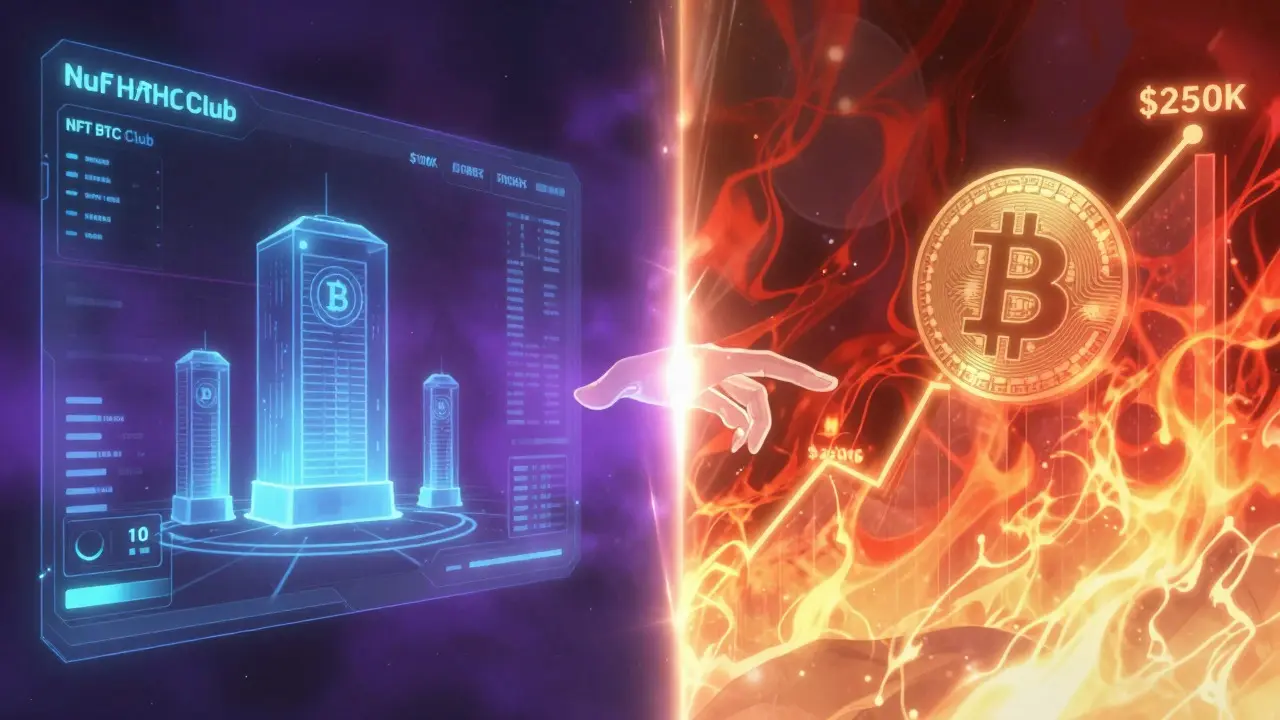
Bull BTC Club (BBC) is a platform that combines Non-Fungible Token (NFT) technology with decentralized finance (DeFi) to represent Bitcoin hash power on the blockchain. Instead of buying physical mining rigs, users mint NFTs that represent specific amounts of computing power. These NFTs can be pledged on the BBC platform to earn actual Bitcoin mining returns. The project uses an oracle protocol to fragment these NFTs into tokens based on the ERC-1155 standard, aiming to solve liquidity issues in the NFT market.
In contrast, BTC Bull Token ($BTCBULL) is a cryptocurrency launched in February 2025 by BCBLL Limited, designed with tokenomics directly linked to Bitcoin's price movements. It raised approximately $8 million during its presale and operates on the Ethereum network. Its primary hook is a milestone-based system where Bitcoin price increases trigger token burns or airdrops of actual Bitcoin to holders.
Neither project has announced a joint campaign with CoinMarketCap. If you see a site claiming "CoinMarketCap x Bull BTC Club Exclusive Airdrop," it is likely a phishing site trying to steal your login credentials or wallet seed phrase.
How Bull BTC Club (BBC) Actually Works
Bull BTC Club isn’t primarily an airdrop farm; it’s a yield-generating infrastructure play. Here is the core mechanism:
- NFT Minting: Users purchase or mint NFTs that represent varying levels of Bitcoin mining capacity (hash rate).
- Pledging for Yield: You pledge these NFTs on the BBC platform. In return, you receive a share of the Bitcoin mined by the associated virtual mines.
- DeFi Integration: The platform features a lending pool. You can deposit mined Bitcoin or other assets to borrow against them or lend them out for interest.
- Fragmentation: Using the BBC-1155 protocol, large NFTs can be broken into smaller, tradable tokens, increasing liquidity for secondary market sales.
The value proposition here is passive income from Bitcoin mining without managing hardware. However, this requires upfront capital to buy the NFTs. There is no "free" entry point unless you count early community bonuses, which are rare and strictly limited.
BTC Bull Token ($BTCBULL): The Milestone Mechanism
If you are looking for airdrops, BTC Bull Token is the more relevant project, but its distribution model is complex and dependent on external market conditions.
The token has a total supply of 21 billion, mirroring Bitcoin’s 21 million cap. Its economy is driven by Bitcoin reaching specific price targets:
| Bitcoin Price Target | Action Triggered | Impact on Holders |
|---|---|---|
| $100,000 | Token Sale Initiation | Public availability begins |
| $125,000 | Token Burn | Reduced supply, potential price increase |
| $150,000 | Bitcoin Airdrop | Holders receive BTC distributions |
| $175,000 | Token Burn | Further supply reduction |
| $200,000 | Bitcoin Airdrop | Additional BTC distributions |
| $250,000 | Major $BTCBULL Airdrop | Large token distribution weighted by holdings |
This structure means the token’s success is entirely tied to Bitcoin’s bull run. If Bitcoin stalls below $100,000, the primary utility triggers never activate. The project also partners with Best Wallet to facilitate these distributions, not CoinMarketCap.
The CoinMarketCap Myth: Why Be Skeptical?
CoinMarketCap is a data aggregator, not typically an issuer of airdrops. While they occasionally host campaigns or partner with exchanges for promotions, a direct "CoinMarketCap Campaign Airdrop" by a niche project like Bull BTC Club is highly unusual and often a sign of deception.
Scammers frequently use the CoinMarketCap logo and branding to create fake landing pages. They ask users to:
- Connect their MetaMask or Trust Wallet.
- Sign a transaction that looks like a "claim" but is actually an approval to spend unlimited tokens.
- Enter their seed phrase (never required for legitimate claims).
To verify legitimacy, always check the official CoinMarketCap blog or Twitter account (@coinmarketcap). If the campaign isn’t listed there, assume it’s fake. As of July 2026, no such official partnership exists between CoinMarketCap and either Bull BTC Club or BTC Bull Token.
Red Flags: How to Spot Fake Airdrops
With the rise of sophisticated phishing kits, visual inspection isn't enough. Look for these technical and behavioral warning signs:
- Urgency Tactics: Messages like "Claim ends in 2 hours" or "Limited spots left" pressure you into skipping due diligence.
- Generic Emails: Legitimate projects use domain-specific emails (e.g., [email protected]), not Gmail or Yahoo addresses.
- Unverified Contracts: Check the token contract address on Etherscan or BscScan. If the code isn’t verified or the creator has a history of rug pulls, stay away.
- Requests for Seed Phrases: No legitimate dApp ever needs your 12-word recovery phrase. If asked, disconnect immediately.
- Too-Good-To-Be-True Rewards: Promises of $500+ in free tokens for liking a tweet are almost always bait to harvest wallet addresses for future drainers.

Tokenomics and Risk Assessment
Understanding the economic structure helps gauge long-term viability. For BTC Bull Token, the allocation is critical:
- 40% Marketing & Growth: High allocation suggests aggressive promotion but also potential volatility if marketing fails.
- 15% Bull Fund: Covers development and operations.
- 15% Burn Reserve: Tied to Bitcoin price milestones.
- 10% Staking Rewards: Incentivizes holding.
- 10% Exchange Liquidity: Ensures initial trading depth.
- 10% Airdrops: Reserved for milestone distributions.
The presale sold 50% of the total supply, creating immediate scarcity post-launch. However, this also means a significant portion of tokens are held by early investors who may sell upon listing, causing price dumps. Bull BTC Club’s tokenomics are less transparent publicly, focusing instead on NFT utility rather than speculative token trading.
Staking and Yield: Real Returns vs. Hype
Both projects offer staking, but the mechanics differ. BTC Bull Token offers high APY staking via Ethereum smart contracts during its Community Sale phase. Rates are dynamic, meaning they drop as more people stake. This is a common tactic to attract early liquidity but often unsustainable long-term.
Bull BTC Club’s yields come from actual Bitcoin mining. This is theoretically more stable because it’s backed by real-world computational work. However, it depends on Bitcoin’s block reward halving cycles and electricity costs. If Bitcoin prices fall, the fiat value of your mining rewards drops, even if the BTC amount remains constant.
Final Verdict: Is It Worth Your Time?
If you are chasing a free CoinMarketCap airdrop, you will likely be disappointed. The most probable outcome is encountering a phishing scam. For serious investors, BTC Bull Token offers a high-risk, high-reward bet on Bitcoin hitting $250,000+. It’s a speculative play suitable only for capital you can afford to lose.
Bull BTC Club appeals to those interested in DeFi and NFT utility, specifically wanting exposure to Bitcoin mining without hardware hassles. It requires upfront investment in NFTs, so it’s not an airdrop opportunity.
Always verify contract addresses on official channels. Use a burner wallet for any new interactions. Never share your seed phrase. In crypto, skepticism is your best security feature.
Is there a real CoinMarketCap airdrop for Bull BTC Club?
As of mid-2026, there is no verified partnership between CoinMarketCap and Bull BTC Club for an airdrop. Most claims online are phishing scams. Always check CoinMarketCap's official announcements for legitimacy.
What is the difference between Bull BTC Club and BTC Bull Token?
Bull BTC Club (BBC) is a platform using NFTs to represent Bitcoin mining hash power, allowing users to earn mining yields. BTC Bull Token ($BTCBULL) is a separate Ethereum-based token whose rewards and burns are triggered by Bitcoin reaching specific price milestones like $100k or $250k.
How does the BTC Bull Token airdrop work?
The airdrop is milestone-based. When Bitcoin reaches certain prices (e.g., $150,000, $200,000), the protocol distributes actual Bitcoin to $BTCBULL holders. A major token airdrop is scheduled for when Bitcoin hits $250,000. Distributions are facilitated through partners like Best Wallet, not CoinMarketCap.
Is Bull BTC Club a scam?
Bull BTC Club itself appears to be a legitimate DeFi/NFT project focused on mining yields, but it carries high risk due to market volatility and smart contract dependencies. However, many *fake* sites impersonating BBC to offer "free airdrops" are scams. Verify all URLs and contract addresses.
Do I need to pay gas fees to claim airdrops?
Legitimate airdrops sometimes require small gas fees for claiming transactions on the blockchain. However, if a site asks you to send ETH or USDT to a "verification wallet" to unlock rewards, it is a scam. Never send funds to claim free tokens.