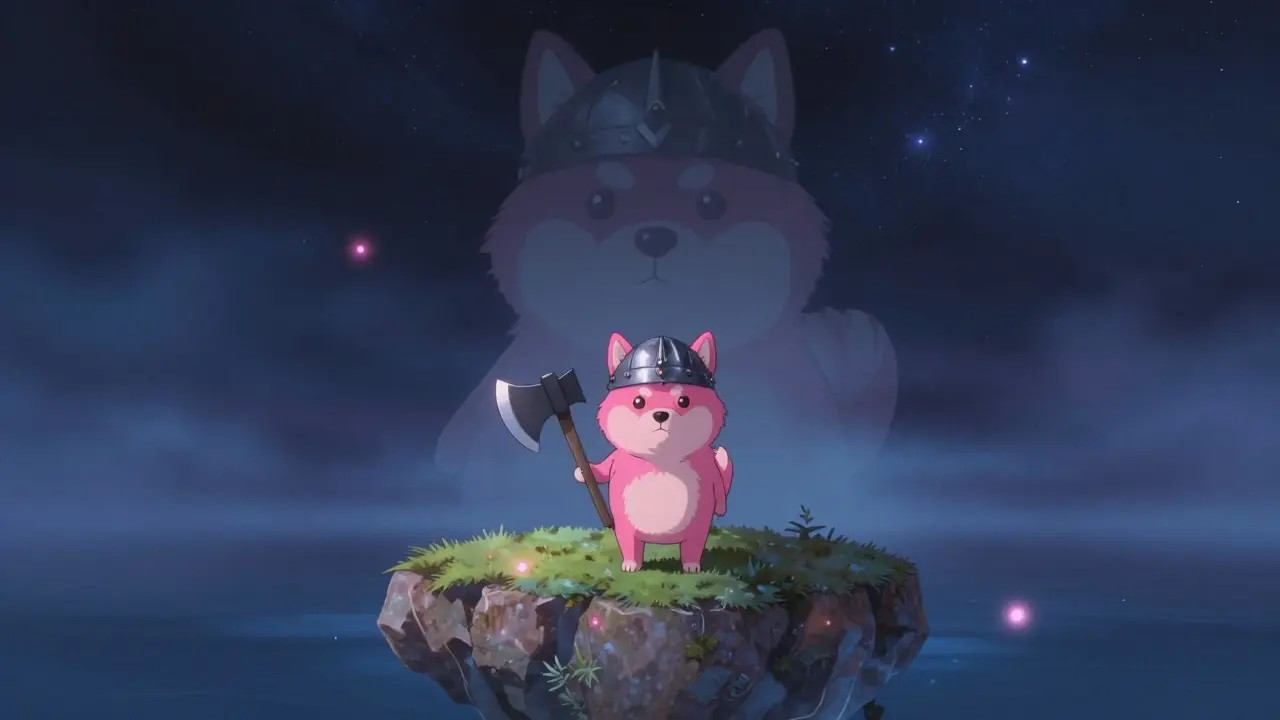
You probably stumbled upon FlokiFork because the name sounds familiar. It shares DNA with the popular Floki Inu ecosystem, but don't let that fool you. FlokiFork (FORK) is a micro-cap meme cryptocurrency with a total supply of 10 trillion tokens and a market capitalization that often dips below $50,000. Unlike its more famous cousin, this token trades on very few exchanges and has almost no daily volume. If you are wondering if it's a hidden gem or a trap, you need to look past the Viking-themed marketing and check the raw data.
The Story Behind the Pink Viking Narrative
Meme coins live and die by their stories, and FlokiFork leans hard into a specific lore. The project brands itself as "Elon Musk's very own Pink Shiba Inu" and frames its community as a crew of "Pink Fork Vikings." This isn't just cute branding; it's central to how the team engages users. They position themselves as rebels fighting against what they see as unfair practices in the crypto space.
The core conflict in their history involves a "rogue developer" who attempted to add a transaction tax to the token. In the world of meme coins, taxes can be controversial. Some projects use them for liquidity pools or development funds, but others view them as a barrier to free trading. The FlokiFork community rallied to remove this developer and restore the token to a zero-tax state. This event created a strong sense of identity among holders, who now see the project as a symbol of community control over code. While this narrative builds loyalty, it also highlights the governance instability that comes with such small teams.
Tokenomics: Why the Price Looks So Small
If you open a chart for FORK, you might think your screen is broken because the price has so many zeros. This is due to the massive total supply. There are 10 trillion FORK tokens in existence. When a project issues trillions of units, the individual price per token becomes microscopic to keep the overall market value reasonable.
Here is the breakdown of the current supply structure:
- Total Supply: 10 Trillion (10T) FORK
- Circulating Supply: Approximately 9 to 9.57 Trillion FORK
- Market Cap: Fluctuates between $30,000 and $90,000 depending on the exchange and date
This tiny market cap places FlokiFork in the bottom tier of all cryptocurrencies. For context, even established mid-tier coins have market caps in the millions or billions. With a market cap under $100k, it takes very little buying or selling pressure to move the price significantly. This makes it highly volatile. A single large sale could crash the price by 50% in minutes, while a small buy order could spike it just as fast.
Liquidity and Where to Trade
The biggest practical issue with FORK is where you can actually buy or sell it. You won't find it on major centralized exchanges like Binance or Coinbase. It is not listed on Binance, which means you cannot easily swap USDT or BTC for FORK using standard interfaces.
Trading happens primarily on smaller platforms or decentralized finance (DeFi) protocols. Recent data shows that 24-hour trading volume is often reported as $0 or negligible amounts, sometimes only a few hundred dollars across all venues. This creates a serious problem known as illiquidity.
| Feature | FlokiFork (FORK) | Typical Top-100 Meme Coin |
|---|---|---|
| Market Cap | $30k - $90k | $100M - $10B+ |
| Daily Volume | < $1,000 | $10M - $1B+ |
| Exchange Availability | Small DEXs / Minor CEXs | Binance, Coinbase, Kraken |
| Liquidity Risk | Extreme (Hard to exit) | Low (Easy to enter/exit) |
When liquidity is this low, the spread between the bid and ask prices can be wide. This means you might pay more to buy than the actual market price and receive less when you sell. If you hold a significant amount of FORK, trying to sell it all at once could drain the available orders, causing the price to drop sharply before you finish your transaction. This is called slippage, and it's a major risk for micro-cap assets.
Risk Assessment: Is It Worth Your Money?
Investing in FlokiFork is less about fundamental analysis and more about speculative gambling. There is no utility, no revenue stream, and no product backing the token. Its value relies entirely on community sentiment and hype. Given the historical context of internal conflicts over taxes and the lack of major exchange listings, the risk profile is high.
Consider these specific risks before putting any money in:
- Exit Liquidity: Can you actually sell your tokens when you want to? With near-zero volume, exiting a large position is difficult.
- Volatility: The token has shown extreme swings. A 14-day RSI reading of 38 suggests it has been oversold recently, but that doesn't guarantee a rebound.
- Governance Instability: The previous incident with the rogue developer shows that key decisions can change suddenly based on community drama rather than long-term planning.
- Opportunity Cost: Money tied up in a token with no growth catalysts is money not working elsewhere.
That said, some traders enjoy the thrill of ultra-low-cap plays. If you decide to participate, treat it as entertainment spending. Only invest an amount you are completely willing to lose. Use limit orders instead of market orders to control your entry and exit prices, and always check the real-time depth of the order book on the specific exchange you are using.

How to Buy FORK Safely
If you still want to get exposure to FORK, here is a practical approach to minimize mistakes:
- Verify the Contract Address: Meme coins are prone to scams. Always double-check the official contract address from the project's verified social channels before swapping. Fake tokens with similar names pop up frequently.
- Use a Reliable Wallet: Since it may not be on major exchanges, you will likely need a Web3 wallet like MetaMask or Trust Wallet to interact with DeFi protocols.
- Check Slippage Settings: On decentralized exchanges, set your slippage tolerance carefully. Too low, and your transaction fails. Too high, and you might get a bad price.
- Monitor Gas Fees: Depending on the network (often Ethereum or BNB Chain), gas fees can eat into small profits. Ensure your transaction size justifies the cost.
Frequently Asked Questions
Is FlokiFork the same as Floki Inu?
No, they are different tokens. While both share the "Floki" brand and Shiba Inu theme, FlokiFork (FORK) is a separate project with its own supply, community, and development history. Do not confuse their contract addresses.
Where can I buy FlokiFork (FORK)?
It is not listed on major exchanges like Binance. You typically need to use smaller centralized exchanges or decentralized exchanges (DEXs) like PancakeSwap or Uniswap, depending on which blockchain the token resides on. Always verify the current listing status before attempting a trade.
What is the maximum supply of FORK?
The total supply is fixed at 10 trillion FORK tokens. Most of these are already in circulation, with circulating supply hovering around 9 to 9.57 trillion.
Why is the price of FORK so low?
The price per token is low because the total supply is extremely high (10 trillion). The market capitalization, which is the true measure of the project's value, is also very small, ranging from $30k to $90k. This combination results in a microscopic unit price.
Is FlokiFork a good investment for beginners?
Generally, no. Due to extreme illiquidity, high volatility, and lack of major exchange support, it carries significant risk. Beginners should stick to more liquid assets until they understand how to manage slippage and exit strategies in micro-cap markets.

Dave Worth
August 25, 2026 AT 01:13They always do this. 🕵️♂️ First they pump the hype with a cute dog story, then they introduce a 'rogue developer' to create artificial scarcity or drama. It’s not a bug, it’s a feature. The 'zero tax' narrative is just a way to make you feel like you’re part of a rebellion against the system, when really you’re just exit liquidity for whoever bought in at the bottom. Check the wallet holdings on Etherscan before you touch it. I bet the top 5 wallets hold 80% of the supply and are waiting for someone stupid enough to buy so they can dump. Don’t let the Viking theme fool you, it’s a trap set by insiders who know exactly how to manipulate sentiment. The fact that volume is near zero means nobody is trading it voluntarily; it’s all bots and insiders moving tokens around to fake activity. You think Elon cares about a pink shiba? No. He’s too busy buying real companies. This is just a mirror to reflect your own greed back at you. Stay paranoid, stay safe. 🚩
Kelechi Precious Nwachukwu
August 26, 2026 AT 23:19Omg this post is so deep!! 😱 I never knew there was such a thing as a 'rogue developer' in crypto, sounds like a movie plot honestly. The part about the price having so many zeros made me feel like my eyes were going blind trying to read the chart lol. It is crazy that the market cap is less than what some people spend on rent in Lagos. I respect the bravery of those who trade these tiny coins but i am scared to even look at the order book because it looks empty. Like if i try to sell will the price just disappear?? The table comparing it to top meme coins was very helpful thank you for making it clear. I think i will stick to stablecoins until i understand more about slippage. But wow, 10 trillion tokens! That is a lot of numbers. 🤯
Valentine Okpala
August 28, 2026 AT 03:59Sigh. Another one bites the dust. 🙄
The irony here is palpable. They brand themselves as rebels fighting against unfair practices, yet they rely entirely on the same speculative mechanics that plague the entire industry. It’s like screaming 'freedom' while being chained to a gold mine owned by someone else.
I find the 'Pink Viking' lore exhausting. We’ve seen this arc before: a catchy name, a vague enemy (the rogue dev), and a promise of community control that evaporates the moment the price dips. The governance instability isn't a feature; it's a symptom of a project with no actual product. When your value proposition is 'we hate taxes,' you haven't built a business, you've built a grudge.
And let's talk about that liquidity. Or lack thereof. A market cap under $100k means the entire project could be bought and sold by a single whale with a bad day. The risk/reward ratio is skewed so heavily toward risk that it borders on negligence. If you're entering this space thinking you're finding a hidden gem, you're likely mistaken. You're finding a hole. And holes don't pay dividends.
It’s a philosophical question, really: is it investment if you can't exit without destroying the asset itself? Probably not. It’s gambling with extra steps. Just say it is. 🧘♀️
Emmanuel Ogbomo
August 28, 2026 AT 23:21Honestly, the 'rogue developer' story sounds like classic community theater to me. In small caps, every conflict is amplified because there are so few players. One person selling their whole bag can crash the price more than any news headline ever could. It’s less about the code and more about the psychology of the group. If the group believes the narrative, the token lives. If they doubt it, it dies. The lack of volume confirms that most holders are either locked in or have already left. It’s a quiet graveyard, not a bustling marketplace.
Melanie Armijo
August 29, 2026 AT 15:16You guys are overthinking it! 🌟 It’s just a coin! Look, at the end of the day, we’re all just chasing dopamine hits in a digital void. Is FORK a good investment? Maybe not. But is it fun? Who knows! The beauty of crypto is that it allows us to imagine a future where our little pink dogs run the world. Sure, the liquidity is scary, but isn’t life risky anyway? I like the idea of supporting a community that fights back against 'unfair' taxes. It feels empowering, right? Even if it’s just vibes. Don’t worry about the contract address too much, just trust the process! Or maybe check it twice, whatever. But keep the spirit alive! 💖
Laine Van Sickle
August 31, 2026 AT 03:28ugh finally someone said it out loud. its basically a casino with a dog face. i tried buying something like this last year and got stuck holding the bag for weeks because the spread was so wide it felt like i was paying a toll fee just to move my own money. dont get me wrong its fun to watch the charts go up and down like a roller coaster but dont call it investing. its entertainment spending. if you cant afford to lose it all then just leave it alone. also the gas fees on eth chain are brutal for small trades so use bsc or something if you must. just dont expect to get rich quick from a coin with less volume than my local coffee shop. ☕️
Ashwin Bhandurge
August 31, 2026 AT 17:45Let's flip the script here! 🔥 Why are we so focused on the risks? Yes, it's volatile, yes, it's illiquid. But that's exactly why it's exciting! Every great empire starts with a handful of believers. The 'rogue developer' incident shows that the community has teeth. They fought for their rights and won. That's a strong foundation. If you believe in the long-term vision of a decentralized, tax-free community, now is the time to get in. Don't wait for Binance to list it; that ship has sailed. Be the early adopter. Take the calculated risk. Use limit orders, sure, but don't let fear paralyze you. The upside potential is massive compared to the downside. Let's build this together! 🚀💪
Teresa Watson
September 2, 2026 AT 02:11yeah sure lets build this together. tell that to the guy who lost his house money on a rug pull last week. the only thing building here is the pile of losers. i love how everyone acts like they are smart investors when they are just gambling with other peoples retirement funds. the 'community control' is a joke when the top holders can dump whenever they want. wake up sheeple. 🐑