
The Big Pivot: From Huobi to HTX
Before you sign up, you need to understand the identity shift. In September 2023, during its 10th anniversary, the company officially rebranded to HTX. This wasn't just a name change; it was a move to distance the global operation from its early Beijing roots and reposition itself as a global financial hub based in the Seychelles.
For a Korean user, this means you won't find a local office in Seoul or a specific KRW-denominated portal. Instead, you're interacting with a global giant that ranks in the top 10 worldwide. It's a massive operation with over 47 million users and more than $4 billion in total assets. If you're looking for the hyper-local feel of a Korean exchange, this isn't it-but if you want access to a global liquidity pool and hundreds of coins, the shift to HTX actually opens more doors.
Trading Costs and Fee Structures
Let's talk money. No one likes getting eaten alive by fees. HTX keeps things straightforward with a baseline trading fee of 0.2% for both makers and takers. Now, for a casual trader, that's fine. But if you're moving large volumes, that 0.2% can start to sting.
The real magic happens in their tier system. By leveling up your account-usually by holding more of their native token, HT, or increasing your trading volume-you can slash those costs. Some top-tier users see their spot trading commissions drop as low as 0.0126%. That is a massive difference when you're scaling a portfolio.
| Attribute | Standard Value | Optimized Value (Tiered) |
|---|---|---|
| Trading Fee (Maker/Taker) | 0.2% | As low as 0.0126% |
| Supported Digital Assets | 700+ Coins | 1,000+ Trading Pairs |
| Payment Methods | ~60 Options | Bank Transfer, VISA, Mastercard |
Asset Variety and the 'Meme Coin' Edge
One of the biggest frustrations with local Korean exchanges is the limited selection of coins. HTX solves this by offering over 700 digital assets. If you're into the high-risk, high-reward world of community tokens, this platform has a track record of spotting trends early.
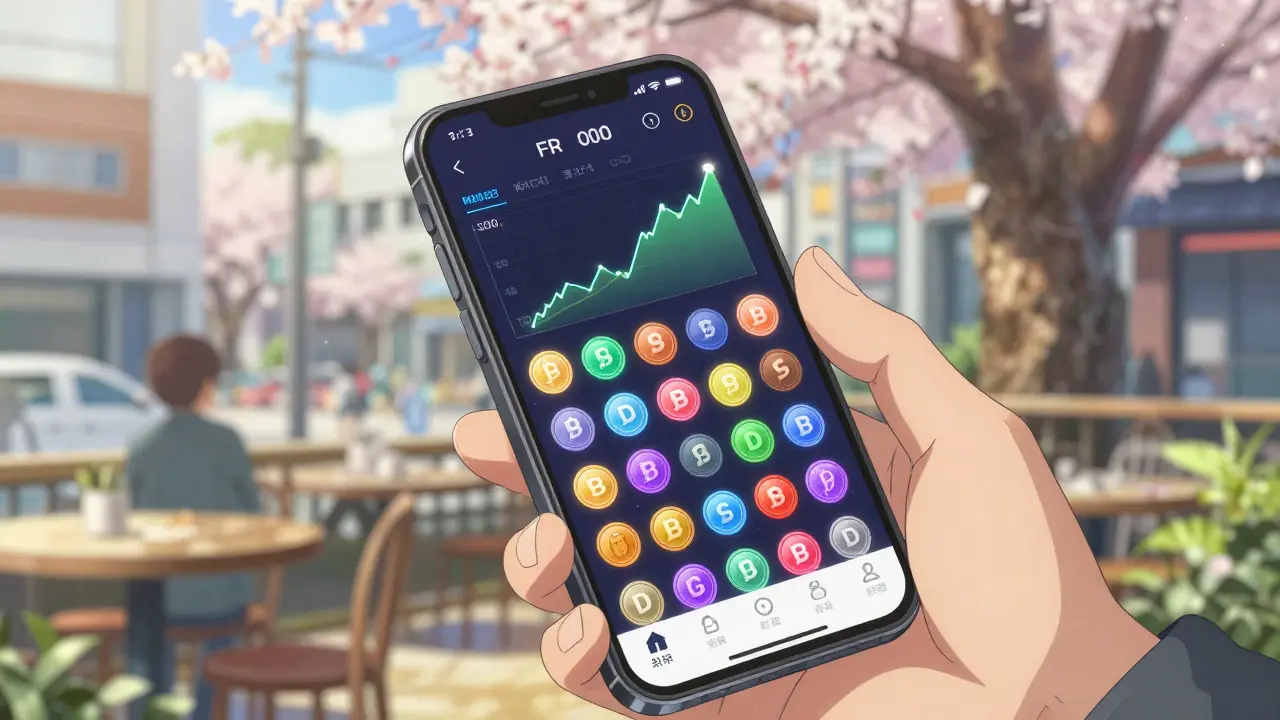
Take a look at their activity in late 2024. While other platforms were lagging, HTX jumped on the SunPump series. They listed SUNDOG early, which saw a 37x increase. They also supported tokens like GOAT and ACT, some of which saw mind-blowing gains during the Bitcoin $100,000 rally. For the adventurous trader in Korea, having a gateway to these assets is a huge advantage over restricted local options.
Security: Is Your Money Safe?
Security is the elephant in the room for any exchange. HTX uses Cold Storage-keeping the majority of funds offline-and employs Merkle tree proof of reserves. This means they provide a mathematical way to prove they actually hold the assets users have deposited.
Is it perfect? No. Like almost every major exchange, they've had security hiccups in the past. However, they've generally been transparent about breaches and have focused on compensating users. In the current landscape, their combination of a long-standing reputation (founded in 2013) and modern reserve proofs makes them a legitimate choice, provided you still follow the golden rule: don't keep your entire life savings on any exchange.
User Experience and Interface
If you've ever struggled with a clunky trading interface, you'll appreciate the HTX design. It's streamlined for both desktop and mobile. The "Buy Crypto" section is particularly intuitive, allowing you to grab over 300 coins directly without navigating complex order books. This removes a lot of the friction that usually scares off beginners.
For the pros, they offer advanced tools like copy-trading, where you can essentially mirror the moves of successful traders. Whether you're using a smartphone on the subway in Seoul or a multi-monitor setup at home, the app remains responsive and clean.

The Regulatory Catch for Korean Users
Here is the part where you need to be careful. HTX operates in 160 countries, but it's not a free-for-all. They strictly follow regional laws and have blocked access in places like the US and mainland China. For Koreans, the experience is generally smooth, but you won't find a dedicated "KRW" (Korean Won) trading pair in the way you would on Bithumb or Upbit.
To get started, you'll likely use one of their 57 supported local currencies or a credit card. You should also be aware that as global regulations like MiCA (Markets in Crypto-Assets) evolve in Europe, HTX is updating its compliance. While Korea has its own strict set of rules, using a global platform often means you are operating in a different regulatory bubble than local entities.
Is Huobi Korea still operating?
There is no separate "Huobi Korea" entity. The entire brand has rebranded to HTX. Korean users can access the global HTX platform to trade assets, but it does not operate as a localized Korean exchange with a separate domestic license.
Can I deposit Korean Won (KRW) directly into HTX?
Generally, no. HTX does not offer direct KRW trading pairs like local Korean exchanges do. Users typically fund their accounts using other supported fiat currencies, credit cards (VISA/Mastercard), or by transferring crypto from a local exchange.
How do I lower the trading fees on HTX?
You can reduce fees by climbing the platform's tier system. This is typically achieved by increasing your trading volume or holding the native HT token. Fees can drop from the standard 0.2% to as low as 0.0126% for top-tier makers.
Is HTX safe for long-term storage?
HTX uses cold storage and Merkle tree proof of reserves to secure assets. While they are a top-10 global exchange with a long history, it is always safer to move long-term holdings to a private hardware wallet rather than leaving them on any centralized exchange.
What makes HTX different from local Korean exchanges?
The main difference is the asset selection. Local exchanges are often limited by regional regulations. HTX provides access to 700+ coins, including high-volatility meme coins and new project launches that aren't yet available in the Korean domestic market.
Final Tips for Getting Started
If you're moving from a local exchange to HTX, start small. Test the deposit and withdrawal process with a small amount of USDT first. Since you aren't using a local KRW portal, your primary goal should be establishing a secure pipeline-either via a credit card or by bridging from a local wallet.
If you're a professional trader, focus on the HT token. Holding the native asset is the fastest way to unlock those lower fee tiers, which can save you thousands of dollars if you're day trading. Lastly, keep an eye on the "Buy Crypto" section for new listings; that's where the platform's strength in the Asian market really shines.


JERRY ORTEGA
April 6, 2026 AT 02:46just keep your stuff in a ledger or some other cold wallet man. centralized exchanges are just honeypots for hackers no matter how many fancy names they use
vijendra pal
April 7, 2026 AT 23:19HTX is legit for memecoins 🚀 i made bank on some random stuff before it hit binance lol. always check the liquidity first though so u dont get stuck in a rugpull 📉🤑
Arlen Medina
April 8, 2026 AT 05:39Who cares if they rebranded to the Seychelles? It's probably just a shell game to avoid taxes and regulations. We need exchanges that actually follow US laws and keep the money onshore where we can actually sue them when things go south
david head
April 8, 2026 AT 22:01true that! those lower fees are a game changer if you trade a lot 💎
Alexandra Lance
April 10, 2026 AT 12:31Oh look, another "secure" platform with a "mathematical proof" 🙄 if you actually believe a company based in the Seychelles cares about your assets you're just begging to be exit-scammed. It's all just a massive simulation to keep the peasants hopeful while the elites drain the liquidity 🤡💅
shubhu patel
April 11, 2026 AT 07:52I think it is quite interesting how these platforms evolve over time to meet the needs of global users, and while the lack of a direct KRW pair might be a slight inconvenience for some, the sheer variety of assets available usually outweighs that small hurdle for most experienced traders who are used to using USDT as a bridge anyway
Sonya Bowen
April 12, 2026 AT 14:26Bridge via USDT. Use a hardware wallet. Simple.
Emily 2231
April 13, 2026 AT 06:46The Seychelles relocation is a clear signal of state-sponsored obfuscation. It is entirely probable that the assets are being tracked by foreign entities to monitor Western capital flow. One must maintain extreme vigilance when utilizing platforms that shift identities so abruptly. The lack of transparency regarding their actual physical infrastructure is deeply concerning. We are seeing the erasure of financial sovereignty in real time. Do not trust the interface. The interface is a mask. They want your KYC data for a database that will eventually be leaked or sold. It is a trap designed to lure in the unsuspecting. Your funds are never truly yours once they enter a global hub. The math they provide is a distraction from the truth. Stay away from globalist financial hubs. Protect your assets. Secure your borders. Believe nothing.
Carol Prates
April 13, 2026 AT 21:15Omg the drama with the rebranding is actually so funny, like imagine changing your whole name just to vibe in the Seychelles! I bet the internal chaos during that shift was absolutely wild, someone probably cried in the boardroom lol
Taylor Meadows
April 15, 2026 AT 12:29Most people here are just gambling and calling it investing. You're all just chasing green candles without understanding the underlying market structure, and it's honestly sad to watch the cycle repeat every few years.
Hugo Lopez
April 16, 2026 AT 08:25I've had a pretty good experience with their mobile app! It's very smooth and the layout makes a lot of sense 😊
Carmelita Gonzales
April 18, 2026 AT 07:09it is always a bit tricky for folks in different regions to find the right fit but a global option can be a good way to explore more coins
Lauren Gilbert
April 19, 2026 AT 06:26It is fascinating to consider how the concept of a localized exchange is becoming obsolete as we move toward a more decentralized global economy, where the physical location of a company's headquarters matters far less than the trust and liquidity of the network itself, though I do wonder if this shift ultimately removes the protective layer that national regulations provide for the average person
Robert Coskrey
April 20, 2026 AT 14:51I concur with the sentiment regarding the necessity of cold storage... It is indeed the most prudent approach!!!